 Town Of Pagosa Springs
Recent dry weather has allowed officials to assess the fallout, including parts of the sewer system knocked out by raging waters. The Pagosa Springs Sanitation General Improvement District - which provides sewer service for downtown Pagosa Springs – suffered damage to all three lift stations, two pumping stations, and a sewer line that runs under the 1st Street bridge on U.S. Route 160.
Electrical equipment in the lift station along with several pumps must be replaced, while pump stations en route to the Vista wastewater treatment plant are operating with dry and submersible pumps. Crews have jetted and cleared sewer lines as well, although officials are looking beyond quick patchwork toward longer-term fixes, said Pagosa Springs public works director Nick Freelen.
“The big problem now is silt and debris that washed into the river,” said Freelen. “The second flood knocked out manholes, which left us open to major failures. Fortunately, that did not happen, but it could have given the situation we were in.”
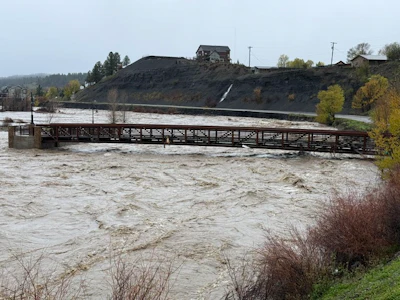
Heavy rains triggered flooding in Pagosa Springs from Oct. 21 to Oct. 25 – another severe storm on Nov. 1 led to additional flooding, as well as mandatory evacuations that were lifted eight days later. A one-two punch of historic floods left planners little time to determine what sewer assets to harden first, Freelen said.
“The short window means we don’t even know what’s broken yet,” said Freelen. “So much silt got into the lines, we couldn’t get a camera crew down there before the second flood hit.”
The fix is in
To offset the lost water line under the 1st Street Bridge, Pagosa Area Water and Sanitation District (PAWSD) tied into a six-inch line south of Route 160. Crews from Durango and Boulder arrived on Nov. 5 to assist with sewer system repairs. Meanwhile, town officials are alleviating worries and confusion about the barrier between Pagosa’s sewer and drinking water networks.
“We’ve got to tell folks that even if there’s sewer water going into the intake, there are still processes in place to ensure you’re not drinking it,” Freelen said.
With winter on the horizon – bringing lows between zero and minus ten degrees – the town is heat tracing sewer lines forced above ground by the floods. High water has slowed some repairs, while officials also weigh the possibility of the San Juan shifting course once levels drop.
“Cobbles and stones were moved [by the flood], and the river could be redirected,” said Freelen. “We’re trying to fix things as we know about them, but we can’t rush to conclusions. Even today the river is still adjusting. It will take weeks and months of new flow over the cobbles to us to the point where the river is stable.”
Possible permanent fixes include a new 1st Street lift station, control system upgrades to existing lift stations, and additional improvements to increase system reliability and prevent future overflow events.
The proposed lift station east of the San Juan could allow the town to bore beneath the waterway. Installing a main line across a to-be-constructed footbridge would provide further protection, though that plan has encountered its own difficulties, said Freelen.
 Town Of Pagosa Springs
Plans further call for rebuilding a flood-damaged foot trail above the main sewer line and routing the pipe through four new box culverts. Looking further ahead, a voter-approved 1% sales tax could help fund a new wastewater treatment plant in Pagosa Springs, ending the necessity to pump sewage seven miles uphill to the Vista facility.
With Pacific tropical systems bringing unusually heavy rains to southwestern Colorado, Pagosa is also examining how these storms are reshaping its floodplain. In the coming years, modernizing aging infrastructure must stay a the top of the town’s agenda, Freelen said.
“I hope people understand what’s going on with the system,” said Freelen. “It’s old and inefficient, and these [floods] brought those issues to light. There needs to be a renewed focus on getting the system fixed in a timely manner.”