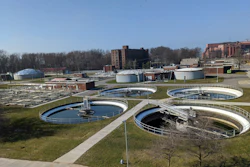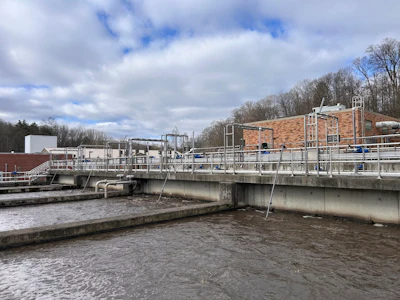

Sludge bulking and foaming are common problems in wastewater treatment plants (WWTPs) during the winter. They can be caused by several different factors, but at North Olmsted Wastewater Treatment Plant (N.O. WWTP) near Cleveland, Ohio, it’s almost always caused by Microthrix.
Microthrix is especially difficult to get rid of compared to other forms of bacteria found in WWTPs. It has the ability to absorb and store long-chain fatty acids without oxygen, and can break them down when oxygen is present.
This means Microthrix can thrive in both anaerobic and aerobic environments, giving it a competitive advantage in WWTPs that cycle between both.
“Our plants are susceptible to a bacteria called Microthrix, and no operator wants that,” says Steven Bagley, Assistant Superintendent of the Treatment Division. “It’s a nightmare. Microthrix affects your settling, and it looks like a thick, greasy foam on the tanks.”
As soon as operators see Microthrix in their system, they need to get rid of it. But before they can do that, they must understand what Microthrix is and what causes it.
What causes Microthrix?
Cold, stagnant conditions create the ideal environment for Microthrix to grow and thrive. Add in a low food-to-microorganism (FM) ratio, or the measure of how much food (organic matter) is available to the microorganisms in a WWTP, and Microthrix becomes a serious problem for operators.
Microthrix is difficult to identify in the winter when the wastewater in the tanks is still. It’s much easier to catch in the summer, when foam starts to bubble and build up in the corners of the tanks—but when it’s warm outside, Microthrix has already taken a strong foothold.
“Once Microthrix takes hold, it will stay there,” Bagley explains. “You have to kill it as soon as you see it.”
More often than not, operators confuse Microthrix with Gordonia, a bacteria that causes similar problems. But by looking at the bacteria stains on slides, N.O. WWTP determined that they were, in fact, dealing with Microthrix.
Bagley and his team have taken an aggressive approach to killing Microthrix. After encountering the bacteria regularly, they’re now skilled at getting rid of it early and fast.
“I try to keep my FM ratio high because I’m trying to combat Microthrix all the time,” Bagley says. “By the time we start getting into the warm weather, as long as your FM ratios are good, you don’t have to worry as much about Microthrix.”
Managing Microthrix is further complicated by nitrogen levels. The EPA regulates how much nitrogen WWTPs can discharge, so plants that have nitrogen limits must manage it—exceeding that limit can result in fines and permit violations.
Finding the right balance
There are two problems that change places as the seasons change: maintaining nitrogen levels and managing Microthrix. N.O. WWTP has learned how to use the winter and the summer to its advantage.
In the colder months, nitrogen isn’t as much of a concern, so Bagley can run air at a higher rate to keep the FM ratio high and fight off Microthrix. But by the time warm weather arrives, Microthrix is less of a threat, as Bagley can cut air to manage nitrogen levels without the tradeoff hurting the plant. “It’s a lot of tweaks and goofing along the way,” he says.
When nitrogen levels are high, it can result in overfertilized waters, which triggers large algae blooms. Once algae blooms die, they deplete dissolved oxygen—this can have repercussions for humans, aquatic life, and the environment at large.
- Human health: If high levels of nitrogen leak into groundwater, it can create a public health hazard.
- Aquatic life: If nitrogen enters natural waterways, high ammonia levels are extremely toxic to fish and other aquatic species.
- The environment: There’s also an environmental cost to the removal process. When WWTPs remove nitrogen, it often expels nitrous oxide into the air. The gas is extremely strong and contributes to global warming.
Every operator must be on the lookout for Microthrix and high nitrogen levels in their wastewater treatment plant. For those struggling to keep these challenges at bay, North Olmsted’s approach is a good one to replicate—and it starts with the right mindset.
“Everything here is a balancing act of making our permit requirements and keeping the bad stuff out of our system,” Bagley explains.
The steps to maintaining that balance are clear: Know your bacteria, know your seasons, and don’t wait for the weather to turn to start fighting back.