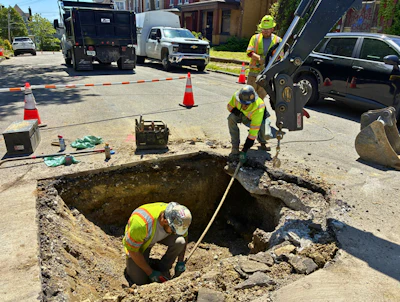
Pittsburgh Water is on the home stretch of its decade-spanning lead service line replacement program. Since 2017, the utility has removed 15,000 public lead water lines and another 11,500 private lines, part of a comprehensive effort to replace all lead connections in its service area by 2027.
Officials including CEO Will Pickering said the completed initiative will protect public health and improve drinking water quality.
“These service lines are old, and can break or leak,” said Pickering. “There are benefits in getting that aging infrastructure out while improving public health. That’s why we’re being so aggressive.”
Pittsburgh’s high-impact rollout comes with a $332 million price tag, funded by Pittsburgh Water through a combination of state and federal grants, rate-payer dollars, American Rescue Plan Funds, and low-interest loans from the Pennsylvania Infrastructure Investment Authority.
So far, the utility has completed or conducted work in dozens of neighborhoods, with additional construction planned through next year. Due to the work’s complexity, Pittsburgh Water has revisited selected communities to ensure complete removal of all lead lines.
PENNVEST is the most recent financial contributor, injecting $31.5 million into the project in early February. Funding consists of a $15.9 million grant and $15.6 million low-interest loan, in addition to the almost $900 million previously secured from PENNVEST for systemwide improvements.
"Pittsburgh Water’s Lead Service Line Replacement program is a critically important investment in our neighborhoods, and we are thankful for PENNVEST's record-setting funding," Pittsburgh Mayor Corey O'Connor said in a Feb. 2 press release. “The program has also supported hundreds of local union jobs and delivered equitable access to drinking water for all families.”
New PENNVEST funding will finance the changeover of approximately 1,610 lead service lines – split almost evenly between public and private - in the neighborhoods of Bloomfield, Shadyside, Highland Park and Central Lawrenceville. Late 2027 remains the target for extraction of all legacy lines, notes Pickering.
“We have urgency to finish by the end of 2027,” Pickering says. “We are
not certain how long PENNVEST funding will be available. But since it
has been available, we saw it as a time to be aggressive. There’s a
lot less out there when it comes to grants.”
Scaling up
Even with the project approaching its end, Pittsburgh Water recently applied for a final PENNVEST payout - likely another $36.5 million - to carry the work through its final year. The initiative also drew $17 million from the American Rescue Plan, facilitating removal of 750 public lead lines.
Other awards include two Pennsylvania Small Water & Sewer grants totaling $850,000. Earmarked for Allegheny County, this money will go to end-user meter upgrades and building out a network of lead-detection sensors.
Meanwhile, Pittsburgh Water is emphasizing efficiency as it removes the last of its lead service inventory. Contractors are using trenchless construction to protect residential front yards, while pneumatic “mole” devices are creating boreholes for new copper service lines to run through.
In addition, the utility is incorporating flexible cross-linked polyethylene (PEX) to reconnect the city's residential water system, said Pickering.
“The goal is to finish these last few neighborhoods – there’s been a lot of work across many neighborhoods on the periphery of the city center,” Pickering said. “In areas with lead paint and dust, we will remove those risks as well. We factored in neighborhood blood lead level data when prioritizing where the work takes place. The goal is to reduce the risk of lead in water at properties where other sources of lead are likely creating a public health concern.”
Pittsburgh Water’s lead removal plans have been challenged by decades-old, often pencil-written records, as well as properties lacking any discernable paper trail. Lead piping was widely used in U.S. plumbing systems throughout the 20th century, particularly in urban infrastructure and older homes.
Cities like Flint, Michigan, suffered from aging pipes leaching lead into the water supply. Pittsburgh had its own crisis in the mid-2010s, with attorney general Josh Shapiro, now Pennsylvania’s governor, filing 161 charges against Pittsburgh Water over elevated lead levels.
Yet, a 2025 report from the utility highlighted a continued drop in lead detected in Pittsburgh’s drinking supply. The system’s 90th-percentile lead level measured two parts per billion in 2025 - far below the federal action threshold of 15 ppb and down from 3.58 ppb in 2024. This marked the lowest reading in the history of Pittsburgh Water, known as Pittsburgh Water & Sewer Authority until its rebranding in 2024.
Pickering said that fresh funding from PENNVEST will keep the utility’s foot on the gas, ensuring crews stay on the streets until every lead line is replaced.
“This grant funding has allowed us to continue our aggressive program, while limiting the need to further increase customer rates,” said Pickering. “If PENNVEST funding was not available, we would likely be unable to afford this scale of project.”