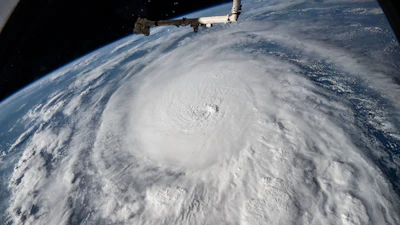
When Hurricane Milton made landfall in October of 2024—only a short time after Hurricane Helene—it left a wake of destruction in its path. Damages were estimated around $34 billion, with the majority of that impact felt in Florida.
One of the communities that felt the storm’s impact was Mulberry, a town located just south of Lakeland that is home to about 4,000 people. Winds ripped through Mulberry at over 100 MPH, and with these gusts came heavy storm waters that were pushed into the community’s water system and overwhelmed treatment capacity. All the while, widespread power outages cut power to the water treatment plant.
In June of this year, the Florida Department of Environmental Protection (FDEP) signed a $19 million loan agreement with Mulberry for water infrastructure resiliency.
It’s the first 100% principal forgiveness loan agreement signed from the 2025 Supplemental Appropriation for Hurricanes Helene and Milton and the Hawaii wildfires (SAHM).
Anatomy of a $3-billion relief package
When the American Relief Act was signed into law in December of 2024, it included $3 billion in disaster relief funding through SAHM. Broken down, the funding came out to:
- $1.23 billion for the Clean Water State Revolving Fund (CWSRF) programs
- $1.77 billion for the Drinking Water State Revolving Fund (DWSRF) programs
This funding was made available to states and territories in EPA Regions 3, 4, and 9 for wastewater treatment and drinking water facilities affected by Hurricane Helene and Milton and the Hawaii wildfires.
Another $85 million was dedicated to CWSRF programs, specifically for states in EPA Regions 3 and 4 affected by the two hurricanes, for decentralized wastewater treatment systems.
In total, Florida, part of EPA Region 4, received $1.7 billion as part of the congressional appropriation to fund eligible projects.
Engineering a storm-ready water system
For small towns like Mulberry, there’s a heavier burden for maintaining and upgrading water and wastewater infrastructure. And when those towns get hit by a hurricane, the problem compounds.
“It only makes it that much worse for them because they don’t have time on their side at that point,” stated Kevin McOmber, the regional administrator for the EPA’s Southeast Region. “It goes from being an operating system to lights out.”
With the SAHM funding, Mulberry will have resources to rebuild for greater resiliency.
For Mulberry, a lot of that work revolves around creating a flood barrier to prevent some of the historic flooding the community dealt with during Hurricane Milton, along with adding a backup power generator to prevent future outages.
To McOmber’s point, while some water and sewer facilities can run off natural gas, other facilities have to bring in diesel or gas tanks to run their power generators.
“You might get a few hours of coverage from a small tank. Bringing in larger fuel tanks provides the ability to have backup power for longer periods of time if a big storm comes through.”
It circles back to the sentiment that what resiliency looks like varies from place to place.
“EPA funding is impact based,” noted Amy Kuhs, a financial analyst in the EPA’s Water Division-State Revolving Fund program. “When you go in to rebuild or upgrade, you’re going to incorporate that resiliency factor that’s hopefully going to prevent that same kind of impact from repeating again when that next event comes. And if it highlights a different vulnerability, then we’ll learn from that and build even better.”
In addition to the flood barrier around the wastewater plant and an emergency generator, Mulberry plans to use the $19 million to fund rehabilitating its sewer system to reduce inflow and infiltration alongside improvements to lift stations.
A season that rewrote the record books
2024 was a historic year for hurricanes. It was one of the costliest seasons on record, and Hurricane Milton, specifically, intensified faster into a Category 5 hurricane than any other storm recorded over the Gulf. Hurricane Helene, meanwhile, intensified at around 50 MPH in 18 hours over the Gulf.
With this rapid intensification, coastal and inland communities, and the water facilities within those areas, are dealt a difficult hand. There’s less time for personnel to prepare emergency measures, and the potential for damage grows.
Combined, Hurricane Helene and Milton caused more than $110 billion in damage.
“Those two storms in particular, and maybe even Helene at a bigger scale, affected five of the eight states in the southeast as part of Region 4,” McOmber said. “The devastation is incredible.”
Two years later, communities are still rebuilding. SAHM funding is supporting those efforts within Mulberry and across other areas.
Tracking Florida's recovery pipeline
To date, there are 10 clean water loan agreements totaling around $125 million, two decentralized system clean water loan agreements for about $18 million, and 15 loan agreements on the drinking water side totaling $304 million. In addition to that, the FDEP is working diligently to award the remaining $1.25 billion to other communities.
Alongside advertisements across multiple outlets and speaking at wastewater conferences, the FDEP has led community meetings for this particular pot of funding as part of the RFQ process. Local governments and communities, as well as local water and wastewater operators, have been encouraged to attend to answer any questions about application requirements and make sure their needs were met.
The FDEP has achieved 100% allocation, with enough applications to cover the allotted $1.7 billion.
As the first community awarded these grant funds, Mulberry is in the planning phase of its project. If everything goes according to schedule, the construction is estimated to be complete by December of 2029.
As storms grow faster and harder to predict, rebuilding like this, and the funding behind it, shifts the story for towns like Mulberry. The next hurricane will come, and when it does, these water utilities will stand ready to brace what the storm brings.