How San Francisco is rebuilding a 1950s wastewater plant for a modern city
Inside San Francisco’s $5B Southeast Treatment Plant overhaul, including new headworks, biosolids upgrades, and lessons for utilities rebuilding aging infrastructure.
Aerial view of the Southeast Treatment Plant's headworks facility looking west.
For nearly 75 years, the Southeast Treatment Plant has been a cornerstone of San Francisco’s infrastructure, treating 80% of the city’s combined sewer flows. The 1950s-era facility was built on 1940s technology, and as its age has started to show, so came the decision to modernize it.
The investment, which totals more than $5 billion, has various roots. It’s a matter of replacing aging infrastructure, meeting stricter treatment levels, minimizing community impact, addressing seismic vulnerabilities and the effects of climate change, and enhancing economic vitality.
The story of the Southeast Treatment Plant’s modernization is a nod to how an urban wastewater plant can undertake an upgrade of this scale while maintaining critical operations.
Screening handling area inside the headworks facility.Robin ScheswohlThe scope and sequencing of facility upgrades
The Southeast Treatment Plant’s modernization includes three major projects:
The development of a new headworks facility to replace and consolidate two of the treatment plant’s former headworks operations. (Construction was completed in 2025.)
A biosolids digester facilities project to replace and change the location of solids treatment facilities. (Construction began in 2019 and is expected to be completed in 2028.)
A nutrient reduction project involving major infrastructure upgrades. (This is currently in the early planning phases, with construction anticipated to start in 2030.)
Defining the scope of the upgrade began with the San Francisco Public Utilities Commission (SFPUC) first defining the levels of service, or what the modernized system needed to achieve. The focus then shifted to assessing the condition and risk of aging equipment and evaluating alternatives, engaging extensively with the community and technical experts to inform decisions.
Balancing costs, environmental benefits, and community impact, SFPUC focused on projects that would provide the most value to ratepayers, sequencing them to keep the plant operational and reduce neighborhood disruption.
Combining modern technology and design approaches
Crews working on fiberglass reinforced plastic at the Biosolids Digesters Facilities Project's odor control facility.Sabrina WongThe new headworks facility
The headworks facility at the Southeast Treatment Plant is responsible for removing trash and debris at the start of the treatment process. The better it protects downstream equipment, the more efficient the entire system becomes.
The new headworks facility is equipped with upgraded fine screens alongside high-efficiency vortex grit removal with 95% efficiency. (That’s a 45% improvement from the previous system.) It also features a new state-of-the-art odor control system, which captures odors at the source and uses unique microorganisms to treat them. These systems are integrated into all new major projects to prevent odors from becoming a nuisance and help SFPUC be a “good neighbor.”
“By capturing more grit, reducing odors, and implementing energy-efficient automation, the SFPUC has brought the preliminary treatment headworks facility into the 21st century," an SFPUC spokesperson stated.
It’s built to treat up to 250 million gallons per day and withstand a magnitude 7.8 earthquake as well as up to three feet of sea level rise.
The biosolids digester facilities project
When wastewater utilities improve biosolids treatment from Class B to Class A (the highest classification), the options for biosolids end-use increase. The infrastructure improvements underway through the biosolids digester facilities project (BDFP) will enable the Southeast Treatment Plant to make that leap.
The BDFP features a pre-digestion thermal hydrolysis process and anaerobic digesters, turning sludge into Class A biosolids that are pathogen-free and safe for agricultural use. While the output is more versatile, the system itself reduces the biosolids handling footprint by minimizing odors, lowering sludge volumes, and enhancing biogas production.
Once operational, the new biosolids digester facilities will capture biogas produced in digestion, upgrade it to pipeline quality renewable natural gas, and inject it into the local utility’s pipeline network.
As the SFPUC spokesperson notes, “by turning waste into clean energy, the facility advances San Francisco’s broader sustainability goals by offsetting fossil fuel use and recovering the biogas from wastewater treatment.”
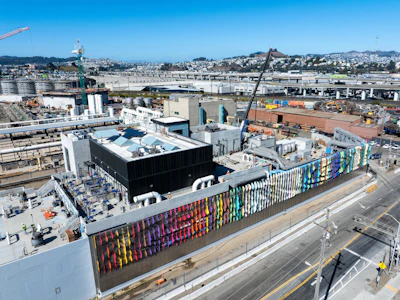
Birdseye view of the Biosolids Digesters Facilities Project and the Southeast Treatment Plant looking east.Sabrina WongOne of the recent milestones on this specific project was painting the exterior of each 60-foot digester with a mix of vibrant blues and greens to mirror the wastewater cleaning process. It’s part of the SFPUC’s broader initiative to make the upgrades integrate with the surrounding neighborhood and feel more like a modern urban facility instead of a traditional industrial site.
Successfully managing complex upgrades at scale
While on their journey to equip facilities with more reliable, efficient, and modern technologies and treatment processes, SFPUC has seen firsthand what strategies and approaches support an upgrade of this size:
✓ Integrate operations and management staff from project initiation through its full lifecycle. Collaboration among planners, engineers, and operators should begin early—spanning needs assessments, alternatives analysis, and design development—and carry through to closeout. During construction, operations staff help review shutdown requests and assess impacts to daily plant operations, with extensive planning and risk mitigation in place well before any system cutover.
✓ Use collaborative contracting strategies for complex, large-scale projects. Approaches like CM/GC and design-build bring contractors in early, enabling constructability review, smarter sequencing, and potential cost savings before work begins. This is especially critical when rebuilding infrastructure at an operating plant, where sequencing, temporary workarounds, and weather planning all factor into maintaining permit-required treatment capacity.
✓ Consider stakeholder interests and pilot new technologies before full-scale implementation. Clear performance goals that reflect stakeholder interests help align decision-making throughout a complex program. Where new technologies are involved, smaller-scale pilots reduce risk and build operational confidence before committing to full implementation.
✓ Engage community members and stakeholders early and often. Transparent, ongoing dialogue on project status and impacts builds trust and reduces friction over a long-duration program.
While no two modernization projects are alike, the questions they raise are often the same. How do you keep a plant running while rebuilding it? Who needs to be at the table, and when? How do you bring a community along on a years-long journey?
The Southeast Treatment Plant perspectives offer a useful lens for thinking through them and making upgrades successful.
 Screening handling area inside the headworks facility.Robin Scheswohl
 Screening handling area inside the headworks facility.Robin Scheswohl
 Crews working on fiberglass reinforced plastic at the Biosolids Digesters Facilities Project's odor control facility.Sabrina Wong
 Birdseye view of the Biosolids Digesters Facilities Project and the Southeast Treatment Plant looking east.Sabrina Wong