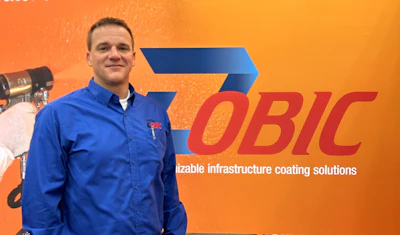

OBIC CEO Dustin Schlachter started his career in the water industry nearly three decades ago. In that time, he has seen the industry shift from open-cut installation to trenchless rehabilitation while dealing with the rising pressures of aging infrastructure, workforce shortages, and funding inconsistency.
From drilling beneath Lake Erie to rehabilitating large-scale wastewater tanks, Schlachter has built businesses to streamline projects in these areas. Today, he argues that the biggest risk facing the water sector is short-term decision making.
Water Daily spoke with Schlachter about funding realities, skilled labor challenges, and why municipalities should invest in long-term water infrastructure solutions—even if they’re more costly upfront.
Water Daily: You've been in water infrastructure rehabilitation for nearly 30 years. What first drew you to the industry?
Dustin Schlachter: Well, I couldn't afford to go to college and my dad took me to a water tradeshow when I was in high school. As we were walking around, my dad and I were talking about the direction of the infrastructure open-cut industry.
We started to look at up-and-coming opportunities, and directional drilling was next. We ended up buying a drill, and I went to a small community college for two years.
As we started down the path of directional drilling, we only had two options back then. One guy showed up and said, “you buy one of these drill rigs and in six months you'll have all the work you can handle.” And the other guy showed up and said, “if you buy this drill rig from me, I'll take you to Toledo and I'll introduce you to people that need directional drillers.”
We went with the second guy for the better part of 30 years because he offered to introduce us to people in need. That's how we got started.
When you first entered the industry, was it rare for people to pursue the same path you did?
In the late '90s, there was this huge push for college, and not enough people were talking about the trades. I'm on the school board in Bryan, Ohio, and I’ve made that my pet project—I always encourage kids to explore the trades. I tell them not to go to college if they don't know what they’re gonna do. Or if they do go to college and get some bogus degree, I encourage them to think about their options.
We're going to need plumbers, electricians, and HVAC people. We're going to need project managers, salespeople, and all these things in the skilled trades that people don't need college degrees for.
You don't need a master's degree to sell coatings or sell infrastructure rehabilitation. Is there a shortage of people? 100%. There's definitely a shortage of people coming into this industry.
A lot of people say this generation doesn't want to work, and I think that's wrong. I think they do want to work, they just don't know what to do or how to do it. It’s a skill problem. We're improving that by teaching young people, upskilling them, and giving them the tools they need to be successful.
You've been an entrepreneur your whole life. On the OBIC website, it says you used to ride your bike with a lawnmower hitched to the back of it so you could mow lawns for money. Can you explain how your entrepreneurship background ties back to OBIC?
The bicycle actually hangs in the conference room now because it’s where our adventure started. My entrepreneurship journey began at the age of 12, and I hired my first employee when I was 15.
I started S&S Directional Boring for water and sewer main installation in '99. Advanced Rehabilitation Technology (ART) started in 2007, and then we grew ART for 10 years to become the largest coatings supplier of a different brand. We identified a few things we could be doing better, and we were bold enough to step up and say so.
After that, OBIC bloomed. OBIC means barrier in Latin, and it’s a coating system for infrastructure rehabilitation that covers wastewater, potable water, stormwater, bridge decks, and industrial applications.
We’re proud of the material and the installer network we've built, and it has grown drastically. It’s the largest certified applicator network of installers in the world currently. Our team has done a good job maintaining that high standard of quality that we expect out of them, and they continue to grow every day.
Being an entrepreneur has been a journey. I’ve technically never worked for anyone in my life, so every day is an adventure for me.
What are some major projects you’ve worked on?
The most interesting project we've done on the water and sewer side of directional drilling would be connecting water to two islands for Put-in-Bay and Gibraltar Island.
Gibraltar Island is owned by The Ohio State University, and they never had water or sewer on the island. So one of the last projects I did before we started up ART personally, was drilling underneath about 900 feet of open water to connect the two islands twice, one with sewer and one with water.
On the coating side, we do a ton of manhole infrastructure rehab, but we also do a lot of big tanks at wastewater treatment plants. We did one tank last year that was a 50,000 square foot lining project, which is an extremely large concrete tank.
We’ve done many different projects over the years. We've coated millions of square feet of infrastructure at this point. I don't even know how many thousands of feet of water and sewer main we've installed in 27 years, but it's a lot.
What do you think is the biggest challenge facing the water industry right now?
I think the biggest challenge is that too much money gets funneled to other projects. When the world is told they're sending $2 trillion to infrastructure rehab, not all that money goes to where it’s supposed to go.
We're just scratching the surface of this problem. Some of these municipalities are in dire need and they require a lot of funding. In turn, there won’t be enough people to do the projects if there is enough funding.
A lot of engineers will say it's not their problem, and they’ll give it to the next generation of engineers because they’re close to retiring. We've kicked the can too long, and now the proverbial can's going to spill over and cause water main leaks.
We’re going to have massive problems in infrastructure in the future because municipalities waited too long to do some of the much-needed things that they need to fix.
How has OBIC navigated these challenges?
OBIC was developed for the wastewater side of the industry. It's been an uphill battle to sell against the things that are already out there.
The biggest challenge we see is municipalities looking at the quickest and cheapest solutions. Our product will never be the quickest and cheapest, but it will be the longest-lasting. So a lot of it is a mindset shift of whether operators want to do the same thing multiple times because it’s less expensive upfront or just do it once for a higher price.
Editor’s note: This interview was edited for clarity and length.