
DC Water is entering the critical repair phase on a damaged section of its Potomac Interceptor, following a collapse that forced the utility to divert wastewater flows through a temporary bypass system near the Potomac River and C&O Canal.
The incident underscores the vulnerability of aging large-diameter interceptors and the operational risks utilities face when a primary conveyance asset fails.
As DC Water explains:
"Repairs are expected to be completed by mid-March, restoring full flow and function to the Potomac Interceptor. At that point the bypass pumping system utilizing the C & O Canal will no longer be needed. Once the collapse site is cleared, work will begin to remove a 30-foot rock dam blocking the pipe. Crews will need to proceed carefully not to trigger another collapse, due to the uncertain integrity of the remaining pipe."
What follows will be a nine- to 10-month accelerated rehabilitation effort covering more than 2,700 linear feet of pipe.
What happened
The Potomac Interceptor, a major trunk sewer conveying wastewater to treatment facilities, suffered structural failure Jan. 19 that resulted in a partial collapse and the formation of a rock blockage inside the pipe.
The obstruction restricted flows and created the potential for wastewater to back up and overflow into adjacent surface waters.
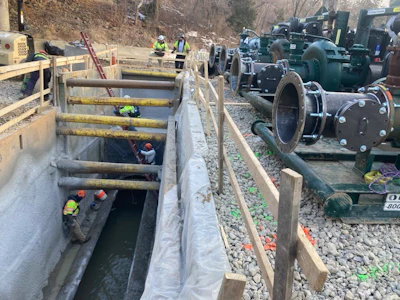
To prevent uncontrolled releases, DC Water constructed a temporary bypass system routing wastewater around the damaged section. Portions of that bypass run in proximity to the C&O Canal, heightening environmental sensitivity and public scrutiny.
While the utility has not publicly detailed the exact structural failure mechanism, large interceptors of this age commonly experience deterioration driven by:
- Hydrogen sulfide corrosion in crown sections
- Ground movement and settlement
- Infiltration and inflow stresses
- Aging reinforced concrete or brick infrastructure exceeding its design life
The presence of a rock dam blocking inspection suggests either structural collapse or surrounding ground instability that introduced debris into the pipe.
Stabilizing the system before repairs
Before crews can access the damaged segment, DC Water had to create sufficient bypass capacity to safely isolate the pipe.
“DC Water crews and its contractors, working under challenging conditions over the past month, are nearing completion of an enhanced bypass system that will allow emergency repairs to begin on a damaged section of the Potomac Interceptor,” the utility reported Feb. 16.
Three additional bypass pumps were brought online to provide capacity and redundancy. However, the utility acknowledged that “the risk of an overflow event remains pending the completion of emergency repairs.”
Crews then installed a steel bulkhead gate to isolate the damaged section. After dewatering the area and beginning excavation to remove the rock dam obstructing inspection, crews successfully reached the damaged section of the Potomac Interceptor Feb. 19.
"Crews today are manually digging out the affected area, carefully removing sludge, soil, and debris from the collapsed pipe. The work is slow and painstaking, as large boulders and rocks complicate the excavation process. Crews are using both manual labor and an excavator to clear obstructions, working carefully not to cause any additional damage."
Why this is happening now
The Potomac Interceptor is part of a broader generation of large urban sewer infrastructure constructed decades ago and now operating under increasing stress.
Several factors make failures like this more likely:
- Aging materials approaching or exceeding service life
- Higher peak flows tied to extreme rainfall events
- Urban development increasing system loading
- Deferred rehabilitation schedules due to funding constraints
Notably, DC Water had already planned rehabilitation work on this section of interceptor. The collapse has effectively accelerated those plans.
Once emergency repairs restore flow and allow decommissioning of the C&O Canal bypass, the utility will move directly into a longer-term renewal phase.
That second phase will take approximately nine to ten months and will use a combination of:
- Slip lining, installing new pipe sections inside portions of the existing interceptor
- High-strength geopolymer lining where slip lining is not feasible
“Together, these methods will rehabilitate over 2,700 linear feet of the interceptor, significantly strengthening its reliability for years to come,” DC Water said.
This hybrid approach reflects modern interceptor rehabilitation strategies, balancing structural reinforcement with constructability constraints in confined urban corridors.
The incident has placed heightened attention on environmental safeguards along the Potomac River corridor.
DC Water said it is developing an environmental restoration plan with federal, state, and local regulators.
The event also highlights the complexity of managing wastewater infrastructure failures in dense metropolitan areas where full redundancy is limited and emergency bypass systems must operate near sensitive waterways.
A broader industry signal
For utilities nationwide, the Potomac Interceptor incident illustrates three key realities:
- Large-diameter trunk sewers represent concentrated system risk.
- Emergency bypass construction is logistically complex and environmentally sensitive.
- Planned rehabilitation programs can quickly shift into crisis-driven acceleration.
As climate variability increases peak wet-weather loading and aging infrastructure continues to deteriorate, utilities may face similar high-profile failures unless proactive rehabilitation programs outpace asset decline.