
There are years when a plant runs the way you’ve been running it, and years when external conditions force you to run it differently. Every wastewater treatment plant operator understands this balancing act.
At the North Olmsted Wastewater Treatment Plant, 2024 fell into the latter category. Extended dry weather pushed flows to less than half of the plant’s design capacity, stretching detention times and shifting the internal balance of the system in ways that were not immediately visible but became increasingly difficult to manage. The issue was not hydraulic. The plant could handle the flow easily. The issue was biological, and it showed up where it often does under low-load conditions: nitrogen removal.
“2024 was an extremely dry year,” says Steven Bagley, Assistant Superintendent of the Treatment Division. “We saw low flows, higher effluent concentrations, and problems meeting our permit for Total Nitrogen.”
For operators, the pattern is familiar. When loading drops, the system does not simply become easier to run. It becomes different in ways that operators must feel out over the years, in ways that aren’t immediately clear in the pure design of the plant. Carbon availability changes, oxygen distribution behaves differently, and the pathways that drive nitrification, denitrification, and phosphorus removal begin to compete in new ways.

A system that already works (until it doesn’t)
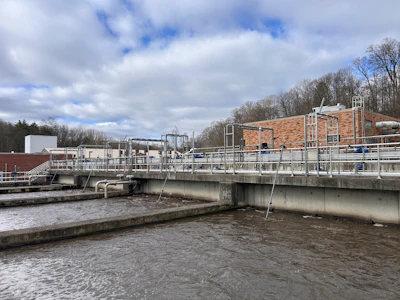
North Olmsted is not a plant that struggles under normal conditions. It is a modern BNR system built around vertical loop reactors, with process control driven by ORP and managed through SCADA. Built in the 1950s and fully redesigned in 2014, the plant is now treats an average of ~6.3 MGD, with the ability to handle extreme wet-weather spikes exceeding 30–38 MGD. Influent is blended with return activated sludge, passes through screening and grit removal, and enters a staged biological process where conditions shift deliberately from reducing to oxidizing.
“The VLR tanks are controlled by ORP probes, and the VDA’s and blowers automatically adjust to changing conditions,” Bagley says. “We operate the four small tanks with negative ORPs and gradually increase the ORP throughout the large tanks.”
That progression is what allows the plant to manage both nitrogen and phosphorus biologically. Lower ORP zones create the conditions for phosphorus release and denitrification. Higher ORP zones complete nitrification and drive phosphorus uptake back into the biomass before clarification.
Under steady-state conditions, the system performs as intended.
“This process works extremely well, and we are generally 85% to 99% under our permit levels with no additions of chemicals,” he says. That level of performance tends to reinforce the idea that the process is stable. What 2024 demonstrated is that stability is conditional.
When carbon becomes the constraint
As nitrogen removal began to slip, the diagnosis was not complicated. Under low-flow conditions, the plant was not short on capacity or retention time. It was short on available carbon in the parts of the system where denitrification needed it most.
“The addition of a carbon source greatly increases nitrogen reduction,” Bagley says. “But these additional carbon sources can be quite expensive.” That tradeoff is well understood. External carbon works, but it comes at a cost, both financially and operationally. The question is whether it can be avoided.
At North Olmsted, that question led to a practical experiment rooted in prior experience. Bagley, who had worked in brewing before wastewater, knew that spent yeast carries a high BOD load. Through a connection with Great Lakes Brewing Company in Cleveland, the plant secured a supply and began feeding it into the first anoxic zone at low doses.
The objective was straightforward: increase nitrogen removal without disturbing phosphorus.
There was some hesitation going in. The yeast was known to be high in BOD, but it also carried phosphorus, and there was no clear sense of how much of that would translate through the process or how the biomass would respond. The initial dosing strategy reflected that uncertainty. Starting low wasn’t just about control. It was about seeing how the system would react before committing to anything more aggressive.
A familiar outcome
The system responded the way theory would suggest. At low doses, nitrogen removal improved without measurable impact on phosphorus. As dosing increased, the gains became more pronounced. By the time the feed rate reached 40 gallons per day, total nitrogen had dropped by nearly 10 percent.
“At 40 gallons a day, we saw almost a 10% reduction in total nitrogen,” Bagley says.
From a single-parameter perspective, the adjustment worked. But biological systems do not operate one parameter at a time.
“We just started to see that uptick,” Bagley says of phosphorus.
At higher dosing levels, phosphorus began to rise in a way that could not be ignored. The added carbon was doing exactly what it was supposed to do for denitrification, but it was also shifting the internal balance of the system, altering how phosphorus was released and taken back up downstream.
The shift didn’t happen all at once. At 20 gallons per day, the increase was still manageable, enough to note but not enough to stop. By the time the feed rate doubled, the trend was no longer subtle. What had started as a controlled test became a clear signal that the system was moving out of balance.
At that point, the decision was less about whether the approach worked and more about whether it could be sustained without creating a new compliance problem. The answer, in this case, was no.
“We had achieved our goal,” Bagley says, “but had to abandon the experiment.”
For most operators, this is not a surprising outcome. It is a reminder that any adjustment that pushes one pathway harder will inevitably influence the others. The system does not isolate improvements. It redistributes them.
Returning to the process
What changed in 2025 was not the problem. It was the approach to solving it.
Rather than continuing to pursue external carbon, the plant shifted its focus back to how the existing process was being run, specifically how oxygen was being applied across the VLR system. The adjustment was simple in description but precise in execution.
“We were able to achieve our total nitrogen removal by lowering the ORP set points in the first three large VLR tanks and increasing the ORP in the last large tank,” Bagley says.
It wasn’t a single adjustment so much as a series of controlled changes. Air was backed down incrementally in the upstream tanks, not all at once, with operators watching how nitrate levels responded across the process. The goal wasn’t simply to lower ORP, but to hold those zones in a range where denitrification could continue without pushing the system too far into conditions that would destabilize the rest of the train.
At the same time, the final tank was pushed harder, creating a clear aerobic finish. That provided a margin of safety for ammonia conversion and ensured that phosphorus uptake remained intact before clarification. The shift was less about hitting a specific number and more about watching how the system reacted as those zones were separated more distinctly.
Over time, the pattern became clear. When oxygen was applied too aggressively early, nitrogen removal suffered. When it was held back just enough, the system began to use its available carbon more effectively. The adjustment worked because it followed what the process was already trying to do, rather than forcing it in a different direction.
For operators, the logic holds. Under low-flow conditions, it is easy to over-aerate early in the process, consuming available carbon before denitrification has a chance to occur. By lowering ORP in the upstream tanks, the plant extended the window where nitrate could be reduced, making more efficient use of the carbon already present in the system.
At the same time, increasing ORP in the final tank ensured that nitrification was completed and that phosphorus uptake occurred before the water left the biological process. The adjustment did not add capacity or change configuration. It redistributed where and how the key reactions occurred.
The result was stable nitrogen removal without the phosphorus penalty introduced by external carbon.
The moving target
What emerges from North Olmsted’s experience is not a single solution, but a clearer picture of how the target moves. The same plant behaves differently under different conditions, even when those conditions fall within what would normally be considered acceptable ranges.
In colder months, higher dissolved oxygen and slower biological activity create a more stable environment for nitrogen removal. In warmer, low-flow periods, the system becomes more sensitive. Detention time increases, oxygen is consumed differently, and the balance between competing biological processes becomes harder to maintain.
“We generally don’t see our nitrogen problems until later in the summer with low flows,” Bagley says.
That seasonal shift is not unique. It is inherent to biological treatment. What varies from plant to plant is how visible it becomes and how effectively it is managed.
What carries forward
 Eric Sandy
The yeast experiment confirmed the mechanism. Carbon limitation was part of the problem, and adding carbon improved nitrogen removal. The ORP adjustment addressed the system. It recognized that the issue was not the absence of a pathway, but the conditions under which that pathway could operate.
When performance shifts, the first question is not what to add. It is what has changed inside the system. Where oxygen is being applied, where carbon is being used, and where the balance between processes has moved out of alignment.
Those questions apply regardless of plant size, configuration, or influent characteristics. They are not specific to North Olmsted. They are part of running any BNR system under variable conditions.
A system that requires attention
Bagley does not present the outcome as a fix so much as a continuation of the work.
“We’re still learning here too,” he says. “Everything changes.”
For operators, that sentiment is less a reflection of uncertainty than of familiarity. Biological systems do not hold a steady state for long. They respond to loading, temperature, and operational decisions in ways that require constant attention.
The plant did not fail in 2024, of course. It responded to a different set of conditions. The adjustment in 2025 was not a redesign; it was a recalibration.
That distinction matters. Because in practice, most performance issues are solved only by understanding what has shifted—and adjusting the system before it moves too far out of balance.