Amazon. Google. Amgen. Abercrombie & Fitch. Bath & Body Works.
There’s no shortage of big industry names that call the New Albany International Business Park home. And that list is growing, with the upcoming arrival of two chip-making fabrication facilities (or “fabs”) to the park located northeast of Columbus, Ohio.
It’s the first time a semiconductor company has come to the area, and it brings unique demands with it. In phase one of the fab project, Intel plans to use five million gallons of water per day.
Being able to meet the targets of heavy water users is rooted in infrastructure investments and decisions made over the course of many years.
In the words of John Newsome, the Administrator of the Division of Water for Columbus: “The fact that we were planning for future capacity in the system is why Intel is able to come here.”
Decades in the making
The Water Beyond 2000 report came out in the late 1990s. It was an initiative launched by the City of Columbus Division of Water in response to a bout of severe droughts. What it became was a springboard for a series of initiatives to maintain a reliable water supply as the region’s population continues to grow.
In 2014, the John R. Doutt Reservoir, a 9-billion-gallon reservoir sitting on 843 acres in northwestern Delaware County, was completed. Two additional reservoirs, meanwhile, are in the design phase to further supplement water supplies.
Along the Scioto River, there’s a $1.6 billion water plant in the works. Designed to be fully operational by 2030, the Home Road Water Plant — the city’s fourth water treatment plant — is expected to supply 48 million gallons of water daily.
“The property for that plant was purchased back in 2015, long before the Intel project was known or announced,” Newsome noted.
Today, the overall system demand for Columbus water is 158 million gallons per day.
A partnership built on shared infrastructure
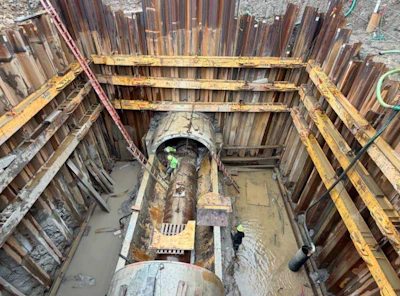
 The construction of the new Home Road Water Plant.
“We knew that we could fit Intel’s phase one capacity into that original plan,” said Jennifer Chrysler, New Albany’s Community Development Director. “What we also knew is that it would put us at the limit of that plan a lot quicker than anticipated.”
To that end, the city of Columbus has worked closely with New Albany on infrastructure to help bolster expansion in the International Business Park. Specifically, they’ve collaborated on a 200-foot water tower along Clover Valley Road that holds 2 million gallons of water. New Albany owns it; the city of Columbus services it.
It’s these types of joint efforts that are a testament to the partnership between the two cities.
“We have an outstanding working relationship with Columbus,” Chrysler noted. “We work together in coordination for capital expenditures on the Columbus side that may be necessary to serve the New Albany system.”
Solving for Intel's specific needs
New Albany’s International Business Park spans 12,000 acres. The Intel project happened to be sited at the very northeast territory of the growth boundary.
“We didn’t think we’d be serving that area until 10 to 20 years out,” Chrysler said.
While planning delivery of service, the city had to be mindful of what would be served between Intel and other underdeveloped areas of the business park.
To Newsome’s point, the fact that there was already a water plant in the works — paired with the fact that it was a pressure pipe system — made it easier to accommodate Intel’s needs. The sewer side of the equation was a bit more challenging.
The Intel site was on the fringe of the water reclamation facility service area. As Newsome puts it: “The plant is a spiderweb. The further you go out, the smaller your pipes tend to be.”
Prior to Intel’s arrival, the city of Columbus had intentionally oversized a sewer to accommodate wet-weather flow conditions in that local service area. That oversizing was a contributing factor, as it provided capacity and storage to serve the new fabrication facilities.
About $101 million in water and sewer infrastructure has been implemented since the Intel project was announced. While that infrastructure serves Intel directly, it also unlocks about another 2,600 acres of opportunity.
“Other infrastructure needs to be built, but we put into place the biggest pieces of infrastructure that would be needed for those 2,600 acres,” Chrysler stated.
Sustainability built into the landscape
Whereas Cincinnati has the Ohio River and Cleveland has Lake Erie, Columbus finds itself in a different position.
“Even though Ohio is a water-rich state, Columbus has to capture our water,” Newsome noted.
The city has to account for reservoirs and groundwater sources. They’re looking at adding a purple pipe loop that could provide an estimated 40 million gallons of recycled water per day to support industrial growth. All the while, water loss remains a point of focus, with the goal of capturing all the water possible to, as Newsome says, “be the most efficient with what we have.”
That same idea flows within Intel’s walls. The company is doing extensive water reclamation work on its own site to recycle the “ultrapure” water that’s needed to manufacture chips. It’s a measure that falls in line with the company’s goal of achieving net positive water use by 2030.
If we zoom out from Intel and to the business park as a whole, you’ll notice a common thread: treed and lawned medians in all the road infrastructure, along with leisure trails and street trees. The city paid for these additions, which are sometimes referred to as “New Albany gingerbread items,” but as Chrysler notes, they have a purpose that extends far beyond that.
“They were sustainability items that we felt were important, so we could control the quantity and quality of the water, as well as water runoff, as these farms were redeveloped into impervious surface,” she stated.
It takes a region to plan for growth
While the city of Columbus and New Albany have worked closely together to support this growth in a responsible way, government entities have also been an integral piece of the puzzle.
The Mid-Ohio Regional Planning Commission (MORPC) provides extensive data around how everything from population growth to industrial use will impact future water supplies. Figures from projected population, household counts, and land use provide estimates for current and future demands within the region.
“All the players that are looking into regional growth are using the same source data,” Newsome stated. “We’re using the same background documentation for projecting things out.”
Meanwhile, the Ohio EPA is conducting state-wide water surveys, with the first being the Central Ohio survey. This is a 15-county study where the EPA is looking at both water and wastewater capacity in the system, as well as the population and industrial growth that’s coming to the area.
It’s these efforts, working alongside one another, that have made growth more achievable.
“Any community looking at that cohesion between development, utilities, and government — all working together — is pretty critical for success in large-scale projects like this,” Newsome said.