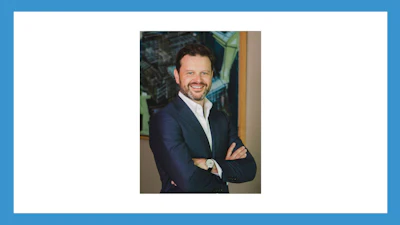

The water and wastewater industry has been historically slow to modernize, and that’s partially due to operator hesitancy around technology adoption. Fluence CEO Benjamin Fash has witnessed this phenomenon for multiple years and on multiple continents.
While Fluence originally took a geography-first approach to business, it has recently shifted to a solutions-focused approach in key growth markets. This reorganization, which began more than three years ago, directly affects how the company sells today, what it prioritizes, and where it’s headed.
In this Q&A, Fash shares more about the vision behind Fluence, common misconceptions about the company, and the water challenges it aims to address over the next three to five years.
Water Daily: Can you give me a bit of background about Fluence and the services you offer?
Benjamin Fash: We provide modular, decentralized water and wastewater treatment equipment. We also provide solutions and services around that equipment so we can operate or maintain any plant that we sell.
We have a pretty broad product and technology portfolio that spans the full water cycle. We can provide solutions for drinking water, for municipal wastewater, industrial water, and difficult-to-treat industrial wastewater as well.
Our reuse and recycling applications are growing rapidly and are important in the world today. We also have a very unique solution for wastewater-to-energy where we can take a heavy organic wastewater stream, treat the wastewater, and then convert the sludge into renewable natural gas that can sometimes defray all or a significant portion of the energy requirements of a facility.
So, we offer a wide array of technologies, and I think that's pretty unusual for a company of our size. We're only about 300 employees, but our team is well-equipped to step into just about any situation and solve whatever water or wastewater challenge our customers might have.
Over several decades, we’ve done more than a thousand installations around the world. That gives us a lot of experience and credibility as a global company.
When a client first comes to you, what are some incorrect assumptions they usually make?
People tend to think that modular just means a containerized solution, but it’s much more than that. Modular really means major components are factory-built, tested, and shipped for rapid assembly. It could mean containerized or skid-mounted to meet tight space constraints.
Either way, modular solutions are a good fit for decentralized applications and have unique advantages such as scalability, shortened delivery timelines, cost certainty, minimal site work, quality control, as well as being portable and easy to deploy.
I think the second answer is there’s a misconception around the breadth of the treatment solutions that we can provide to our customers.
For example, we are well-known for our ultrapure industrial water treatment solutions in certain regions, while in other parts of the world, we’re known for our municipal wastewater treatment technology or our waste-to-energy solutions. But those customers don't necessarily know that we can treat everything across the spectrum.
I think that's a result of the company not doing as good of a job as we could have in communicating all the strengths and capabilities that we offer. We've really tried to change that over the past three years by strategically repositioning around our key products, solutions, and end markets.
Historically, the company was geographically focused. For example, we had Fluence South America and Fluence Italy, and they would sell very specific applications into their own geographic market. Our strategy in recent years has been to take the products and solutions where we have unique competitive advantages and market those in regions that are new for that product line, but not new to the company, taking advantage of our geographic scale.
We have started building momentum by taking those products abroad because we do have offices in just about every continent in the world. So, we can offer solutions to a variety of opportunities that we're seeing.
You serve several industries in the water space. Is there one you serve more than the others?
We're quite diverse in the markets that we serve, and it’s pretty evenly split. When we reorganized the company around our four core products and end-markets, there were three product-focused business units and one geographic one.
We have municipal water and wastewater, which provides drinking water and sewage treatment. That can be sold to either a municipality, or it could be to a land developer, a resort owner, or a private buyer of municipal infrastructure.
The industrial water and reuse division deals with source water applications. A lot of ultra-pure, high spec, very niche requirement water for a particular industrial process. We serve a lot of different industrial customers, including semiconductor fabricators, steel manufacturers, refineries, power, and food and beverage. We also provide water reuse and recycling systems. In certain parts of the world, water is one of their largest costs and biggest risks, so they will try and reuse as much water in their process as possible.
We also have our industrial wastewater and biogas business that sells a lot into food and beverage because the type of wastewater that they're treating tends to be higher strength organic waste streams. Meat processors, dairies, and things of that nature tend to be the larger customers for that business.
Our revenue segmentation is fairly diverse depending on the year. No one industry really dominates. What we're probably best known for is our municipal solutions for wastewater treatment as a result of our proprietary MABR technology and related solutions.
Your product portfolio is pretty diverse. Is there one technology you find yourself reaching for more often?
We're probably best known for our municipal wastewater technology. Our flagship proprietary technology is our MABR (membrane aerated biofilm reactor) membrane which has patents all over the world. We manufacture these membranes in China, and we're planning to build manufacturing capabilities in North America too.
That membrane sits at the core of multiple wastewater treatment products, including a modular, containerized system (AspiralTM Flex) as well as a larger format for greenfield applications, larger plants, and retrofits (SUBRE). The MABR membrane is known for being the lowest energy wastewater treatment product for nutrient removal, specifically nitrogen, and works particularly well in cold weather environments.
The nutrient removal requirements are getting more stringent, especially in North America and other developed economies around the world. Not only is our technology highly effective at removing nutrients from municipal wastewater, but it is more energy efficient than any competing technologies we run up against.
There's still an education process that we need to continue to work through with customers, but we’ve been able to prove its effectiveness with well over 300 installations around the world over the past decade and it's getting more and more established, especially in North America.
What is the biggest challenge that Fluence is focused on heading into the next few years?
Our biggest focus today is establishing acceptance for the MABR membrane technology, particularly in North America. The water and wastewater space tends to move a little slower than other industries in terms of accepting technology, but when you have as many installations as we do around the world, people start to catch on and see what the advantages are both in terms of energy consumption, ease of operation, and the ability to scale up when a municipality’s wastewater treatment plant is out of compliance, underperforming, or they need to increase capacity due to population growth.
We just need to continue to increase both the knowledge and the comfort with the technology.
Editor’s note: This interview was edited for length and clarity.