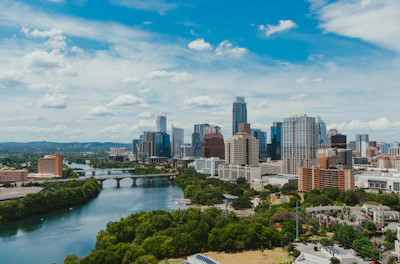

Austin Water has served the Austin area for more than 100 years, and aims to keep that strong presence going. To achieve this, it launched Water Forward—Austin’s unique hundred-year water resource plan.
“The plan develops and implements environmentally conscious water management strategies to adapt to growth, drought, and climate change,” says Randi Jenkins, deputy director of technical services. “It will ensure we can provide water for the city of Austin for the next hundred years.” Randi Jenkins, deputy director of technical services at Austin Water
The plan was officially approved by city council in November 2024, and includes three sustainable water management strategies: conservation, reuse, and new water supply.
The GoPurple program is an integral part of the plan, specifically for reuse efforts.
Three paths to water reuse
The GoPurple program operates through three approaches:
- On-site water reuse: Treating water from roof runoff and air- conditioning condensation to be used for nonpotable water. This includes urinals, irrigation, and cooling.
- Decentralized reclaimed water systems: Using domestic wastewater reuse to distribute treated water into buildings.
- Centralized reclaimed water systems: A purple pipe network pumps treated water throughout the city, providing nonpotable water to developments that can hook up to it and use recycled water in their buildings.
To put these systems into practice, Austin Water created guidelines to ensure new building developments are aligned with its water reuse efforts. As of May 2026, new commercial, multifamily, and mixed-use development facilities 250,000 square-feet or larger are required to implement on-site water reuse systems or connect to the city’s centralized water system.
“We’re targeting large-scale developments because they make the biggest impact,” Jenkins says. “Over time we’ll have phased implementation where we decrease those size requirements.”
Affordability, Jenkins says, is a challenge, but it’s also an opportunity to incentivize developers.
The GoPurple program is funded by a Community Benefit Charge (CBC) of 15 cents per thousand gallons of water used. This results in $1.47 added to the average residential water bill per month, and $10 million per year.
The city provides incentives for developments that are complying with the reuse requirements and offers additional incentives for voluntary reuse systems. This includes expedited permit reviews, an on-site reuse system pilot, and a reclaimed water pilot. More information and applications can be found on the Austin Water website.
Tracking milestones
By 2040, Austin Water aims to save 16 million gallons per day; the utility ensures it stays on track by monitoring specific metrics.
“We’re tracking the number of reclaimed water meters in our centralized system, the number of new water mains installed, and the amount of reclaimed water we’re using,” says Teresa Lutes, managing engineer at Austin Water. “That information is helpful in seeing how those programs are being implemented and where we need to make adjustments.”
The program is also tracking the amount of on-site water reuse system incentives that are being used and extension rebates that tie back to the GoPurple program.
Austin’s population growth is another key part of the equation. “It’s an important metric for tracking water use efficiency,” Lutes says. “That’s tracked in gallons per capita per day.”
Considering Austin’s impressive growth in population, it’s important to keep track of how many people Austin Water serves. The city currently serves 1.1 million people, but should serve more than 3 million people in the next century—that’s exactly why the 100-year plan exists.
GoPurple in action
The GoPurple program was just passed two years ago, so it’s relatively new to the city of Austin. As a result, the buildings that are complying with water reuse regulations are still under construction. However, Austin’s Permitting and Development Center has its very own on-site blackwater system.
While small, the Permitting and Development Center can treat 5,000 gallons per day and has cut their potable water demand by 75%.
Larger developments are showing what’s possible on a greater scale.
There are campus-wide developments that focus on rainwater and condensate—these projects are much larger and can save even more water per year.
“Some have utilized our incentive program to install their own blackwater system to meet their own sustainability goals,” Jenkins says. “These campuses are treating hundreds of thousands of gallons per day, so we’re looking at 60 million gallons per year or more.”
In addition, several county facilities have retrofitted their buildings—their cooling towers have converted to using reclaimed water instead of drinking water in their evaporative cooling systems. This would save hundreds of thousands of gallons of water every month as well.
Austin Water’s plans moving forward
At present, there are about 80 miles of reclaimed water pipes in Austin Water’s service area. Compared to Austin’s 4,000 miles of potable water pipe, Jenkins says, the city has a long way to go.
“We need more purple pipe in the ground all over our service area,” she explains. “But it takes time to engineer those plans, design those pipes, and put them into service.”
Austin Water is developing its long-range reclaimed water program that will determine what it should tackle next. Currently, it is focusing on expanding its centralized water systems, decentralized water systems, and making key infrastructure upgrades.
Since 2024, reclaimed water has come a long way. It originally began as an effort to supplement irrigation, but reclaimed water is gradually becoming a third utility for the city.
“It’s not just used for irrigation anymore, it’s also used for essential services like flushing toilets,” Jenkins says. “In order to have a system that stands up to that task, it needs to be robust, resilient, and redundant.”
There are infrastructure projects happening today, with purple pipe running through local neighborhoods to help build the redundancy the system requires.
“We have demonstrated that this is technically feasible,” says Katherine Jashinski, supervising engineer at Austin Water. “We get outreach from other cities wanting to learn more about our ordinances and how implementation has gone. They could be working on their own version of a Water Forward plan.”