Situated on the coast of Lake Erie, Johnson’s Island is home to 270 residents — some seasonal, some who stay year-round. Five years ago, more than 50% of those property owners petitioned for a change to their water infrastructure.
While part of the village of Marblehead, Johnson’s Island is the one part without village water. Residents have long relied on water storage tanks and wells for potable water. Owners wanted to move away from that approach and connect with a more centralized source.
What has followed is a project requiring careful considerations to extend the pipeline over water and preserve the history the island holds dear.
Digging through bedrock
Wells are limited in capacity, and the water quality isn’t great. With cisterns, you have to pay water haulers to fill them. For island residents, the goal was safer, ample, more reliable drinking water.
What’s limited the push for better water in the past is visible: the island’s heavy rock formations.
“In some places, rock is a foot or two down,” noted Dan Barr, senior project manager at Verdantas, the consulting firm that has been heavily involved in the island’s waterline project. “You scrape off a little dirt, and you’ve got solid bedrock.”
It’s what’s made it hard to put infrastructure in the ground, and why big rock trenches are needed.
Every dig pushes toward the initiative’s result: running a pipeline in the water that will provide fire hydrants for the first time and deliver water service to the edge of owners’ properties.
While not spelled out in the project, to Barr’s point, “the assumption is that the wells and cisterns would go away.”
Sinking a pipeline without disturbing the bottom
 A typical road on the island.Verdantas
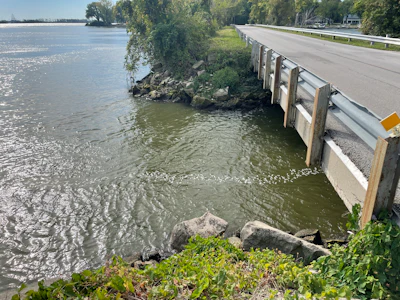
The new project involves extending that pipeline across the Sandusky Bay of Lake Erie.
Working their way through the U.S. Army Corps of Engineers permit, Barr and the Verdantas team have designed the system so the pipes can be floated to their dug-out destination and then sunk. They use articulated concrete block mattresses to ensure the pipe doesn’t float up, and can pull the pipe up when repairs are needed.
Outside of underwater pipeline protection, these mattresses are also used for erosion control. That application has proven to be beneficial in this context, too.
“Because it’s an erosion control product, anything growing on the bottom of the bay will grow through it,” Barr stated. “Army Corps really liked that plants could go right through it.”
To Army Corps’ point, it was a question of what’s on the bottom now and if it will still be there.
Water lines and burial grounds
Today, Johnson’s Island is made up primarily of a private, gated community of residences. But within its 300 acres, there’s also a historic Confederate cemetery that’s accessible to the public.
While located within Ohio’s “Vacationland,” the island is also, as of 1990, a National Historic Landmark. During the Civil War, the island was the site of a prisoner-of-war camp where captured Confederate officers were held. More than 200 of those prisoners were buried in the Confederate Cemetery. A monument was later built to commemorate the prisoners of war.
Dating back even farther than that is a thread that ties the island to Native American history. Before European settlement, indigenous people inhabited and visited Johnson’s Island to use the area’s resources, with stone tools, fragments of pottery, and other artifacts discovered.
The layers of the island’s history, which make its story all the more dynamic, proved to be a hurdle in permitting for the waterline project.
As part of their review process for the waterline extension, the Army Corps looped in Ohio’s State Historic Preservation Office (SHPO). While the permit was for the causeway crossing, SHPO — with the intention to preserve cultural and historic resources — wanted to know what was happening on the island and provide their input.
Specifically, SHPO was worried about any disruption to artifacts on the island.
In light of that, Verdantas hired an archaeologist during the design phase. They also used ground-penetrating radar (GPR) around the cemetery.
“There was concern that there might be graves outside the cemetery boundaries,” Barr noted. “We used GPR to survey all the areas outside where we were going with the water main.”
The archaeologist was also on site during digging to see if anything of importance surfaced.
Breaking ground at last
Bids for the island’s waterline project opened up earlier this year. Shoreline Contractors won the bid for the construction of the bay crossing. D2 Excavating LLC will handle the installation of the waterline on the island.
More recently, the Ohio EPA issued a Finding of No Significant Impact (FONSI), with clearance of any significant adverse environmental impacts.
The Village of Marblehead has also qualified and been approved for an $8 million, 0% interest loan via Ohio EPA’s Water Supply Revolving Loan Account (WSRLA).
These are exciting milestones on what’s been a long road. A few years from now, as it’s anticipated, residents on Johnson's Island will have something they've never had before: water that's simply there when they turn on the tap.