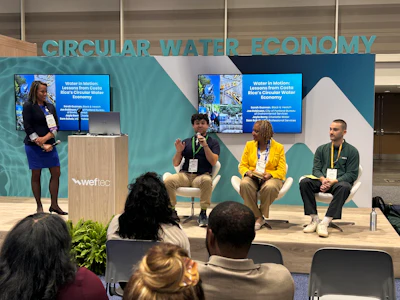

What does a circular water economy actually look like in practice?
For a group of young U.S. water professionals who traveled to Costa Rica earlier this year, the answer was broader than simply recycling more water.
At a WEFTEC panel on Monday, representatives from the City of Portland Bureau of Environmental Services, Charlotte Water, and MSA Professional Services shared lessons from the first Young Professional Circular Water Economy Tour, organized through a partnership between the Water Environment Federation and nonprofit Global Water Stewardship.
The week-long trip exposed participants to approaches spanning water reuse, resource recovery, conservation, and community-based water management. Back at WEFTEC, panelists said some of the most significant lessons involved reconsidering what it means to reduce, recover, and regenerate resources in the first place.
For Joe Robinson, who works with Portland’s Bureau of Environmental Services, the most striking examples centered on reducing water demand.
In Monteverde’s cloud forest, for example, participants encountered dry toilets that compost waste on-site rather than relying on conventional wastewater infrastructure. “It’s not just for survivalism, it’s for reducing your demand,” Robinson said. He described the approach as potentially providing “a more affordable and more sustainable way” to meet basic sanitation needs.
Looking for resources in the waste stream
Other examples demonstrated how circularity can extend well beyond water conservation.
At a solid waste facility in Guanacaste, participants saw on-site leachate treatment integrated into the operation. Rather than treating the resulting water strictly as another waste stream, the facility put it back to work on-site.
“They use that on-site treatment,” said Sam Scholz of MSA Professional Services. “They spray it down for dust control and worm control.”
For Scholz, the example demonstrated the potential for circular practices even within facilities fundamentally designed to handle waste.
That concept already has parallels in the U.S. wastewater sector.
Scholz pointed to biosolids recovery and reuse, nonpotable water systems, and internal water reuse at wastewater plants as examples of circular practices already emerging domestically.
But getting further, he said, will require water professionals to look beyond individual treatment processes and consider how water intersects with the communities and systems around them.
“We’re so dialed in on one specific topic that we kind of forget that it involves so many others outside of water as well,” Scholz said.
Charlotte Water’s Jayla Berry described the shift in similar terms.
Instead of thinking about wastewater treatment as a linear process with a defined beginning and end, she said utilities can increasingly ask what can be recovered and reused along the way.
“It’s like a mindset shift,” Berry said. “Instead of thinking of things like, okay, this is how we treat wastewater, think about it, okay, well, what if we did it in a different way? Or what if we recovered it in a different way?”
Resource recovery is already taking shape
Robinson pointed to renewable natural gas as one example of that thinking moving into practice at U.S. wastewater facilities.
Wastewater treatment produces biogas that facilities must manage. Rather than treating that gas solely as a waste product, some utilities are capturing and processing it into renewable natural gas that can be put to productive use.
“There’s value in it, economic value and functional value,” Robinson said.
For utilities, he said, resource recovery can create an opportunity to address multiple challenges at once: managing a waste stream while producing something useful and potentially improving local reliability.
“How can we take this waste product and how can we do something with it that makes this more affordable, more long-term reliable?” Robinson said.
A community-level approach
Still, some of the panelists’ biggest takeaways had less to do with individual technologies.
Robinson and Berry both pointed to the community-oriented nature of several Costa Rican projects they visited. In one case, Robinson described a cooperative through which residents took responsibility for local water, education, infrastructure, and economic needs.
“Imagine getting together with 2,000 of your neighbors to be like, we need clean water, we need education, we need bridges. How do we make that happen?” Robinson said.
Berry similarly highlighted the emphasis on nature-based solutions and communities working with the resources already available to them.
“Even if they don’t have the most money in the world, they still were like, we need to solve these problems, so there’s got to be something we can do,” she said.
For U.S. utilities, the lesson from the trip was not necessarily to replicate Costa Rica’s systems wholesale. Instead, the panelists described circularity as a broader way of approaching water management: reduce demand where possible, recover resources that would otherwise become waste, and consider how water infrastructure can provide value beyond its traditional treatment function.
Some of that transition is already happening at American wastewater facilities. The question raised at WEFTEC was how much further that thinking can go.