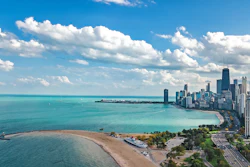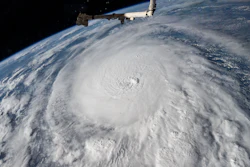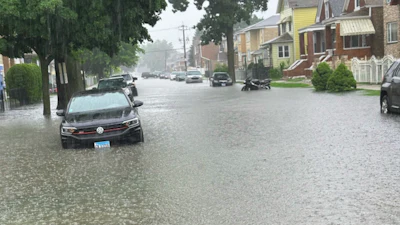
In the summer of 2025, Chicago was battered by a handful of 500-year and 1,000-year rainstorms just weeks apart. These and similar storms are not just a danger to the public- they are also forcing cities to rethink how to develop and maintain sewer infrastructure in the climate change era.
In civil engineering, “design storms” are defined by the statistical likelihood of a rainfall event occurring in a given year. For example, standard flood control systems rely on historical precipitation records, targeting one-, five-, 10-, 50-, and 100-year storm thresholds.
But as extreme rainfall becomes more routine, the shortcomings of 20th-century hydrology become harder to ignore. The result of climate change and warming global temperatures, heavier storms are also redefining principles of stationarity on which stormwater systems were built.
Put simply, past weather trends can no longer accurately predict future risks, said Michael Sansone, a Chicago-based civil engineer.
“The design life of sewers, bridges and roads is 50-100 years,” said Sansone, also co-founder of CRIO Systems, a startup that builds sensor networks for municipal sewers. “When building a sewer, you have to consider what water management will look like 100 years from now.”
Historically, a 10-year storm had a 10% probability of being equaled or exceeded in any given year. A one-in-1,000-year rainstorm, meanwhile, is now defined by the National Weather Service as having a 0.1% chance of occurring in a given year. The updated languages clarifies that extreme storms can strike in consecutive years, regardless of past weather.
In water management terms, design storms are meant to help city planners stay on task. Ideally, these events will become a blueprint for green and gray stormwater infrastructure, said Sansome.
“It’s a cost-benefit analysis, where cities are charged with designing the most efficient systems based on what they expect with these rainfall events,” he said. “Overdesigning means going over budget, so cities must incorporate these standards and make responsible decisions.”
Change in the offing
In recent years, shifting storm patterns have made municipal infrastructure improvements a moving target. In 2025, the state of Illinois released Bulletin 76, which updated statewide rainfall benchmarks while factoring in increases in future precipitation.
Though civil engineering standards evolve slowly, more stormwater managers are abandoning outdated assumptions about rainfall. How that actually equates to change on-the-ground is the question, said David Lampert, associate professor of engineering at the Illinois Institute of Technology.
As rainfall grows both more frequent and intense, the resulting surge in stormwater runoff should logically push planners to expand sewer network capacity. However, larger pumps and pipes are needed to handle that additional discharge, a costly proposition as cities continue to reevaluate the future of stormwater safety, said Lampert.
Europe is ahead of the curve regarding this critical work, he said. Hamburg, Germany, implemented a “sponge city” framework where porous surfaces, green rooftops, retention basins, and real-time weather station data protect overburdened sewer networks from drainage overload.
At the same time, Chicago’s deep-rock tunnel networks serve as a blueprint for other metros, even as structural vulnerabilities remain..
“Those projects are proactive and have been well-received,” Lampert said. “But Chicago still had basement flooding when it was hit by big storms last year. And it’s a flat city, so it takes a longer time for water to run off.”
What’s the solution?
With historical weather data failing to reflect modern climate realities, urban planners can no longer rely on century-old rainfall records, said Lampert. Smaller solutions such as pervious green space are a start for cities wanting to plan ahead – officials should also consider eminent domain to convert “low land-value parcels” into new wetlands, he added.
New engineering standards should also be informed by forward-looking climate science, with improvements spread to people of all socio-economic backgrounds, Lampert said.
“We need all-of-the-above solutions for stormwater management, just like we do for climate change itself,” he said. “None of these programs individually can address the issue, but they each help to alleviate the problem to some extent.”
Individual regions of the U.S. will have to define their own design storm criteria, said Sansone, the Chicago engineer. Precipitation frequency data from the National Oceanic and Atmospheric Administration (NOAA) can, at least, help municipalities devise individualized strategies around sewer and stormwater infrastructure.
“Engineers can look at where to increase capacity and water storage, where to upgrade pumping stations, and where maintenance must take place,” Sansone said. “But do these models accurately represent what’s happening on the ground? It’s hard, because there’s high spatial variability in rainfall, and storms can travel unpredictably. There’s assumptions in data you can monitor to see if they hold, and calibrate your models to better inform yourself about stormwater capacity or prioritizing maintenance.”
In 2023, New Jersey adopted an Inland Flood Protection Rule to ensure any new development utilizes climate-informed data. Ultimately, individual states and cities must decide which engineering standards best match their local sewer needs, said Sansone.
“It’s about consistency, regulatory compliance and long-term planning,” he said. “Water does not respect municipal boundaries, but infrastructure budgets do.”