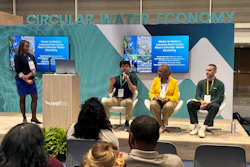

Who will step into leadership roles when the silver tsunami hits the water workforce? That was the million-dollar question at a WEFTEC panel on Monday.
Three professionals with different experiences in the water industry shared how they’re building a leadership pipeline for water utilities:
- Helen Hagos, director of performance and accountability at WSSC Water
- Justin Roush, associate professor of economics at Xavier University
- Amber Lavoie, director of human resources at Toho Water Authority
Technical skills aren’t enough
The problem starts with how utilities promote. Their best operators and engineers are often technical experts who have never been taught to lead.
“We have a lot of amazing, technically skilled employees,” Lavoie said. “But when faced with going into a leadership role, they don’t have the skills they need to be successful.”
When a new leader can’t think strategically, the utility is less prepared for the challenges ahead. And the silver tsunami, the coming wave of retirements, is inevitable. The panelists focused on what can be done to soften its impact, starting with who gets in the pipeline in the first place.
Getting the word out
Many young people are attracted to careers in AI and technology, and most aren’t aware that careers in the water sector even exist.
“We think about the Deloittes of the world, we think about KPMG, or any of those big consulting firms, they go directly to the universities to make them aware,” Hagos said. “Water careers aren’t always presented. I think there needs to be more partnerships with universities to bring that awareness to students.”
Once people are in the door, Lavoie said, the next job is helping them see what that work means. When she first joined Toho Water Authority, she was amazed at how many employees it takes to make water flow when the faucet turns on and drain when the toilet flushes. That’s why every hire does a “Toho tour.”
“Everybody who joins our company gets to spend the day traveling our service area and watching our employees do what they do in real time so they understand what a lift station is and what actually happens at a plant,” Lavoie said.
The tour has built ambition. Call center workers, Lavoie said, have wanted to become operators after seeing the work in action.
Growing the people you have
Attracting people is only half the challenge. The other half is showing them where they can go.
To move employees up the ranks, Toho Water Authority offers skill-based progression. “We’ve created 70 different tracks to make sure when somebody walks through the door at Toho, they don’t have to guess what’s next,” Lavoie said. “We’ve put the employee in the driver's seat, giving them the opportunity to design the career they’ve always wanted.”
WSSC also invests in developing its people so they have the skills to advance into leadership. Promoting high performers is natural because they’re technically sufficient, Hagos said, but utilities should also consider professionals from other industries.
“We bring folks into leadership positions and we never talk about teaching them the business,” Hagos said. “How can we have a new HR director sit at the table with the rest of the executive staff and not know the business?”
Passing on the wisdom
Education can close the skills gap, and that’s where Roush’s work comes in. Seasoned operators have long passed on their knowledge informally, but that approach has limits.
“So far, it’s been a patchwork of wisdom sharing through war stories or webinars,” Roush said. “All these things work, but they tell you one thing that solved a problem.”
Xavier University launched a Master of Science in Water Utilities Management program to advance water and wastewater professionals into leadership roles. The university developed the program with WEF and AWWA to ensure it serves the industry.
“When it came to building the program, we realized we couldn’t do this alone,” he said. “It’s really a partnership between the water community and us. We teach fundamental business strategies, finance, marketing, economics, but we’ve also hired that wisdom to teach in the program.”
Those seasoned water workers have been trained to teach online, covering rate setting, utility finance, capital planning, and asset management. The program was designed for people who have utility experience in drinking water and wastewater.
“We have people three years in and 20 years in, we have HR directors and VPs, and we have superintendents and people on the ops side, so the knowledge sharing has been incredible,” Roush added.
Hagos said that kind of exchange should run in both directions. Senior leaders need to know the business so they can sit at the table, and technically savvy employees need managerial skills: communicating, writing, and selling ideas.
“You need to have a command of your knowledge,” Hagos said.
Giving leaders a safe place to land
Developing leaders also means letting them fail. The panelists stressed that new leaders need room to take risks and a safe place to land when a decision goes wrong.
“If you take a risk and you fail, you learn a ton in adjusting it for next time,” Roush said. “We call it failure pedagogy.”
Lavoie said leaders share that responsibility.
“As leaders, our job isn’t just to have a title and collect a paycheck,” Lavoie said. “It’s truly to develop the next generation of leaders.”
Raising awareness, mapping career paths, teaching technical experts to lead and giving them room to fail: together, those steps answer the question of who will step up when the silver tsunami arrives.