Every watershed has a story to tell, and in Lake Erie, that story is being told in real-time.
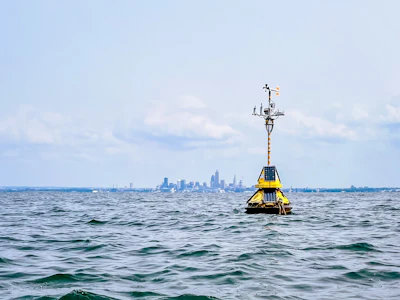
In the warm weather months, Cleveland Water Alliance (CWA), a nonprofit organization focused on driving innovation in the Great Lakes, deploys smart buoys across the Lake Erie watershed. Once out in the water, these smart devices deliver real-time information on the lake’s atmospheric and weather conditions, wave levels and currents, and water quality parameters.
In an industry where the default has been sampling to get water quality snapshots, the Smart Lake Erie Watershed project is making waves.
“Having some of these smart devices is certainly expanding,” noted Ebie Holst, the director of data and innovation at Cleveland Water Alliance. “We’re seeing it more in the Great Lakes, but Lake Erie, by far, is the most advanced of the Great Lakes and really the first to build it out.”
The impact of that build-out is shaping everything from the way recreational users engage with the lake to the treatment decisions that local water utilities make.
Bringing a network of smart sensors out into the lake
 Cleveland Water Alliance and Freeboard Technology
To keep costs down while transmitting data from multiple sensors, CWA opted for LoRaWAN as its sensor networking protocol. This allowed them to deploy a higher volume of less expensive devices. It also meant they needed to put these gateways on tall buildings. That involved researching the owners of different locations and establishing partnerships, alongside working through relevant permits.
With the network in place, the next priority became sensor placement. Collectively, these decisions have been made in close alignment with where the water intake is around the basin.
With support from the Cleveland Division of Water, the initiative started with two buoys and grew to four. Backed by the state of Ohio, the project has grown to at least one buoy in every county that touches Lake Erie. Additional devices and buoys have been added over the past few years, which takes us to today, where there are 200+ sensors spread across 7,750 square miles.
The story that these Lake Erie sensors tell
Across all the different stations—from weather and marine stations to land-based stations—the sensors measure shared parameters:
- Wind speed and direction
- Surface pH levels
- Surface chlorophyll levels
- Surface blue-green algae levels
Generally, land-based stations focus more on water levels, as well as atmospheric and wave conditions. That’s the heart of the information that’s provided to recreational users who, in Holt’s words, want to know: “Is it safe for me to take my kayak out there? What will sailing be like?”
Depending on where the buoys are located and who’s using the data, other information may be gathered. To name one consideration point: How vulnerable is water to harmful algal blooms?
To Holst’s point: “The Western basin has a much wider range of different sensors related to tracking harmful algal blooms. To the central and east, we’re more focused on hypoxia issues that we tend to see in the lake.”
For utilities, these are big topics of concern. There’s the public health impact to consider, as well as how the water looks and smells. If hypoxic water, for instance, gets into the water intake and adjustments haven't been made in the chemicals to account for that, it will have a pronounced impact on the taste and odor. Customers may get worried, and ask if the water is safe; and even though it is, Holst notes, “it’s hard to convince people of that when it smells and tastes weird.”
The more advanced notice utilities have, the smoother the chemical treatment change goes.
How real-time insights helped Cleveland Water buy time
The CWA’s smart sensors monitor parameters at different depths of the lake’s water. Hypoxia tends to have a correlation with temperature, so as it gets colder toward the bottom of the lake and that cold starts to climb, there’s a tendency to see hypoxia levels climb, too.
“Even if we didn’t have extensive gauges to see the hypoxia, we could see the temperature changes,” Holst stated.
From these insights, Cleveland Water was able to make a proactive move: raise the lip of their intake that was, at that time, pretty deep underwater. Raising that lip bought them back up to six hours of time to change over their chemical treatment approach.
 Cleveland Water Alliance and Kogent Studios
Access to that information meant Cleveland Water could avoid raising concerns from customers and maintain trusted relationships. It also meant they didn’t have to worry about sending out extra workers to go flush the hydrants, which can quickly become a big cost and labor issue.
Insights that feed interest in learning more
As utilities have adopted the use of real-time data, they’ve naturally landed on the question of, what else can I see?
With utilities looking for more nuance around hydrocarbons, CWA has added oil detection sensors on a few deployed buoys. As part of these efforts, they’ve conducted research on where to put early warning systems around the basin, where there is oil and gas activity, to detect where there might be different types of spills.
Sometimes the need is less about new parameters, but rather pivoting to address current ones. Utilities have asked to move sensors in cases where there are concerns over hypoxia and the direction it seems to be coming from or harmful algal blooms. By moving a buoy or station, it creates more room to capture data earlier on and provide a warning sign for specific conditions.
All the while, CWA has one buoy that can be deployed as needed to test new trial technologies.
It’s these efforts, alongside the initiative as a whole, that speak to where CWA’s focus lies: collaboration that drives innovation to solve real-world water challenges.