
At the WWEMA Washington Forum & Emerging Leaders Meeting, two sessions from very different vantage points landed on the same conclusion:
Data center growth driven by AI is emerging as a new class of water demand, and utilities are not yet fully positioned to manage it.
Demand is scaling faster than infrastructure
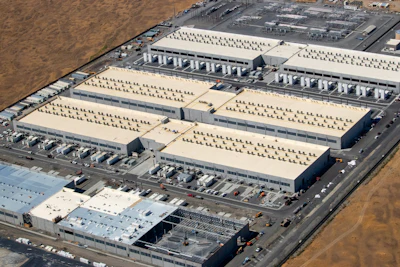
From the infrastructure side, Kevin Olsavsky of Michael Baker International made clear that the scale has shifted. Traditional large data centers once operated in the range of 100 megawatts. New AI campuses are being planned at one to two gigawatts or more.
That increase in computing power carries a direct implication for water use. Cooling requirements scale alongside energy demand, and at the upper end, a single campus can require millions of gallons of water per day, placing it on par with small municipal systems. In practical terms, facilities of that size are no longer incremental additions to demand. They function as system-level loads that must be planned for in the same way as new population centers.
That demand is also moving geographically, following power availability into regions like Texas, Appalachia, and the Southeast, where water systems are not always built to accommodate it. The result is a planning mismatch. Data center developers are working on timelines measured in months, while water infrastructure is planned and financed over years. Utilities are often brought into projects after siting decisions are already made, limiting their ability to influence sourcing strategy or long-term system impacts.
Water use is not being measured consistently
Dr. James Olds of George Mason University highlighted a parallel issue: the industry does not yet have a clear or consistent way to measure its water footprint.
While energy efficiency in data centers is tightly tracked, typically through metrics like power usage effectiveness (PUE), water usage effectiveness (WUE) remains unevenly applied. Some operators track it closely, but many do not, and there is no standardized requirement for reporting or benchmarking water consumption across facilities.
That lack of consistency makes it difficult to compare facilities operating at vastly different scales of power and water use. Without a common framework, utilities and regulators are left evaluating projects individually, even as aggregate demand increases. WUE is intended to bridge that gap by expressing water use relative to energy consumption, but its inconsistent application limits its usefulness as a planning tool.
At the same time, overall water use is already significant. U.S. data centers consumed an estimated 17 billion gallons of water for cooling in 2023, with projections pointing to rapid growth as AI adoption expands.
Utilities are becoming part of the siting equation
That combination of scale and limited visibility is beginning to shift how projects are evaluated. In regions like Northern Virginia, data center demand has moved from a marginal consideration to a primary driver of water system planning. Facilities are now being treated less like large customers and more like infrastructure loads that can reshape system capacity, storage, and distribution requirements.
Water is also emerging as a gating factor alongside power and land. Even where water is physically available, permitting, environmental review, and public perception are influencing whether projects move forward. That places utilities in a more strategic role, but only if they are engaged early enough to shape outcomes.
Public opposition is becoming a constraint
Public engagement is now a defining variable in that process. Data centers are increasingly facing local opposition tied to water use, energy consumption, land use, and noise, particularly in areas already experiencing rapid growth or resource constraints.
Water use, in particular, is becoming a focal point. Large facilities drawing millions of gallons per day can be difficult to contextualize for the public, especially when there is no consistent metric like WUE being used to explain how that demand relates to energy output or economic value. That lack of clarity can amplify concern and contribute to project delays or additional regulatory scrutiny.
For utilities, this introduces a new layer of responsibility. Supporting data center development requires clear communication about water sourcing, system impacts, and long-term sustainability. Without that transparency, utilities risk becoming part of the opposition narrative, even when they are not the primary decision-makers.
The policy framework is still developing
Despite the scale of demand, water remains largely absent from federal AI policy discussions. Olds noted that while there are champions for AI and for water in Congress, there are few focused on the intersection of the two.
There is no consistent federal framework governing water usage reporting, no standardized application of WUE, and limited integration of water considerations into broader infrastructure or technology policy. That leaves utilities navigating a rapidly evolving demand landscape without clear regulatory direction.
Utilities still have leverage, if they move early
Utilities that engage early in the siting and planning process have an opportunity to shape how this buildout unfolds. That includes setting expectations around water sourcing, defining infrastructure contributions, and establishing demand management and reporting requirements.
WUE could play a central role in that process. As a standardized metric, it offers a way to connect water demand directly to energy output, allowing utilities to benchmark facilities, compare proposals, and communicate impacts more clearly to regulators and the public. Without it, each project is evaluated in isolation, even as facilities scale into gigawatt-level operations.
At the same time, AI itself is emerging as a tool for utilities. Applications in leak detection, predictive maintenance, and demand forecasting offer a path to reduce non-revenue water and improve system efficiency. In that sense, the same technology driving new demand may also help offset some of its impact.
The takeaway
For utilities, the issue is not simply that data centers use a lot of water; it is that AI-driven infrastructure is introducing demand that is tied directly to energy output, scaling rapidly, publicly visible, and not yet fully governed, while the tools to measure and manage that demand, including WUE, are still developing.
The infrastructure is being built now. Utilities that want to be part of that buildout will need to engage earlier, define expectations more clearly, and communicate more effectively with the public. Those that do not may find themselves reacting to both a demand profile and a regulatory framework that have already been set.