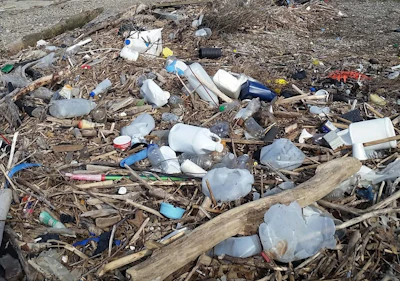
From foam foodware to plastic bags, pre-production pellets, and microfibers, the impact of plastic pollution is growing across the Great Lakes. A 2024 report from nonprofit conservation group Alliance for the Great Lakes found that 86% of litter collected on the lake system’s beaches is composed either partially or fully of plastic.
Plastic is a threat to clean water and human health, while posing immediate dangers to birds, fish and other wildlife. Nor does the general public fully understand the hazard posed by this increasingly ubiquitous detritus, noted alliance senior policy advisor Andrea Densham.
“People have an understanding around plastic they see in their trash, but plastic pollutes twice,” said Densham. “There is the pollution that takes place during production, as well as what ends up in our lakes and streams.”
Regional environmental groups including Denham’s are not standing by as the problem gets worse. The Alliance for the Great Lakes is collaborating with, among others, state advocacy group Environment Illinois on holding industries and companies accountable across the entire plastic product life cycle. The organization is also campaigning for policies that would mitigate the most harmful single-use plastics clogging the waterway.
The first step in tackling such a sweeping issue is fully grasping its scope, Densham said. According to the 2024 alliance study – based on 20 years of data collected by Adopt-a-Beach volunteers across all five Great Lakes – about 22 million pounds of plastic contaminate the 94,000-square-mile system.
Much of this waste comes from plastic beverage bottles and other single-use items, though tiny plastic pieces are common along shorelines. Then there are “nurdles,” lentil-sized pellets used as a raw material in the manufacture of plastic products.
While coastal areas contribute to the problem, the Great Lakes being a plastics production hub makes the region uniquely susceptible to large-scale pollution. Besides larger items, microplastics and even nanoplastics are also invading our environment, said Densham.
“Plastic trash goes into our waterways, often from landfill runoff,” she said. “Micro and nanoplastics are coming through our wastewater systems. The smaller the particles, the easier they can transport through those systems.”
Clear and present danger
Most plastic trash does not naturally dissipate in the environment. Instead, this waste breaks down into toxic particles that seep into the lake complex. Microplastics have been found in human blood and lungs – fish and shorebirds eat styrene and small plastic pieces, with ingestion damaging their endocrine and reproductive systems.
Since plastics clearly threaten both human health and the environment, federal, state, and local laws are needed to reduce this pollution long before it reaches the lakes. Densham’s group is calling for Extended Producer Responsibility policies that make offending companies responsible for the design, materials and end-of-life management of their products.
Putting packaging producers on the hook is common across Europe and Canada. In the U.S., states including California, Minnesota, Colorado, Maine and Oregon have laws that put the onus on these businesses to pay for the collection and sorting of recyclables. Ideally, this method will minimize waste at it source and create a circular economy for recycling.
“It’s like buying a new computer from Best Buy – when I’m done I can bring it back, and they have a system to dispose of it safely,” Densham says. “Best Buy will collect that item without issue. Let’s do that for packaging, too.”
That’s the law?
Truly controlling plastic pollution requires active legislative intervention, said Densham. This year, the alliance advanced a suite of bills in Illinois around the elimination of prevalent pollutants, namely foam food ware, plastic bags and those pesky plastic pellets.
Plastic foam, for example, is the third most common litter item collected during the alliance’s beach cleanups – Americans use about 5.6 billion pieces of this material annually, leading to the proliferation of microplastic particles.
Meanwhile, several states bordering the Great Lakes have introduced laws to cut down on plastic microfibers, including a recent proposal in Illinois that would mandate microfiber filters in new washing machines..
North of the border, Canada is combatting plastic waste via new regulations, initiatives and international collaborations. Plastic is now considered toxic under the Canadian Environmental Protection Act, paving the way for a permanent ban on some single-use items. The long-gestating decision shifted critical attention to freshwater bodies, an area often overlooked in favor of ocean pollution.
“People are saying, ‘Don’t forget about freshwater, because this is not just a marine issue,” said Eden Hataley, a University of Toronto Ph.D. student studying microplastic pollution management and policy. “We’re coming to understand that pollution in freshwater meets or exceeds what’s being reported in the ocean.”
The ban is part of Canada’s larger effort to achieve zero plastic waste by 2030. What’s still lacking is an organized effort to monitor this pollution in the larger Great Lakes system – in January, the International Joint Commission’s Great Lakes Science Advisory Board proposed improved regional coordination to systematically measure the scope of the problem.
“There is a rich history of monitoring in the Great Lakes, where we’re looking at mercury, heavy metals and other pollutants,” Hataley said. “We just need to figure out how microplastics fit into that existing work.”
Densham of the Great Lakes advocacy group said the tracking of plastics should work “hand-in-glove” with producer responsibility.
“Let’s set up a system on responsibility that’s best tied in with monitoring,” said Densham. “We need to move policymakers on both sides of the aisle in the right direction.”