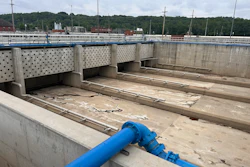
Prime Hook National Wildlife Refuge in Sussex County has undergone restoration to mitigate damage caused by intruding saltwater.
Delaware is grappling with a saltwater invasion, an issue that intensifies during the summer heat and the more frequent dry periods of recent years.
“We’ll hear complaints from people that their water tastes salty, or they’ve tested their water and found salt in there,” said Alison Rogerson, an environmental scientist with Delaware Wetlands, which operates under the Delaware Department of Natural Resources and Environmental Control (DNREC).
Brackish drinking water is just one consequence of saltwater intrusion and inundation in the state. Residents are noticing more dead trees on tidal rivers, along with proliferation of “ghost forests” on the coast. Characterized by bleached-white trunks, these decaying sentinels are a stark visual of the abnormally high salt concentrations edging in from the Atlantic.
DNREC is monitoring saltwater creep alongside its divisions of water, watershed stewardship, and climate, coastal and energy. Just as crucially, officials are educating the public on the difference between saltwater intrusion and inundation. Whereas intrusion is saltwater moving into an aquifer where freshwater is present, inundation is marked by overland saltwater flooding, either during storms or from the steady encroachment of daily tides.
Saltwater contamination is aggravated during times of little to no precipitation – in late 2024, Delaware and other northeastern states went more than a month without measurable rain. While June finds Delaware clear of drought, state watchdogs continue to scrutinize the environment for a briny invader impacting wells, wetlands and habitats.
Landward movement of saltwater can be exacerbated by large-scale aquifer pumping. Even heavy rainfall won’t immediately flush out a contaminated aquifer – fresh groundwater levels must first increase enough to repel the saltwater seaward, noted DNREC hydrologist Amber Bataille.
“A well impacted by saltwater can take a couple of months, or even years, to become fresh again,” said Bataille. “Aquifers move slowly, and need more rain to push that saltwater back out.”
In addition to making water both undrinkable and unusable for irrigation, saltwater can harm ecosystems and corrode public infrastructure. Homeowners or businesses seeking an untainted aquifer will pay a hefty price – building a deeper well costs upwards of $10,000, compared to a regular well’s $3,000 price tag, said Bataille.
A rising challenge
Sea level rise is forcing more saltwater onto Delaware’s coasts, although inland areas of the state are not immune to this intrusion. Inundation can happen in forests, croplands and wetlands, with the Mid-Atlantic coastal plain’s flat geography making matters worse. Delaware has the nation’s lowest average elevation, making the state doubly vulnerable, added Rogerson, the environmental scientist.
Both saltwater intrusion and inundation can affect tidal rivers, though the problem remains most substantial along Delaware’s coast. With the Mid-Atlantic a sea level-rise hotspot, saltwater is pushing inland at an increased pace, affecting both surface and groundwater.
Areas battered by storms are at risk as well. Prime Hook National Wildlife Refuge in Sussex County experienced significant inundation during Hurricane Irene in 2011, while Superstorm Sandy caused severe damage to beach barriers a decade later. The resulting saltwater influx killed off freshwater wetland plants, leaving behind mudflats, ghost forests and damaged agricultural fields.
A post-Sandy restoration project in 2016 successfully repaired breached marshes, restored dunes and rebuilt the damaged shoreline. Meanwhile, roughly 4,000 acres of refurbished tidal marsh now supports a stretch of barrier beach along the Delaware Bay, said Kate Toniolo, project leader at the Coastal Delaware National Wildlife Refuge Complex.
“Since that restoration, there has been minimal additional saltwater intrusion into upland areas,” Toniolo said in an email. “The previous storms and restoration had the most significant impacts on habitat change. As a result, the ghost forest areas are slowly converting into salt marsh in some places.”
Testing, testing
Prime Hook officials are collaborating with DNREC on more ways to transform the area into a salt marsh. Potential solutions include the clearing of dead trees, as well as introducing plants better suited to a brackish environment.
Otherwise, the refuge continues to operate as usual, Toniolo said.
“Outside of the storms that led to the restoration, saltwater intrusion hasn’t been an ongoing issue,” she said. “The main challenge is just continuing to restore those areas that were initially impacted.”
Understanding the full effects of saltwater migration requires extensive monitoring, said hydrologist Bataille. For instance, a study of 15 coastal sites by DNREC’s Wetland Monitoring and Assessment program (WMAP) examined wetland habitat impacts from saltwater inundation and sea level rise.
WMAP scientists found that as saltwater gradually moves inland, it eliminates freshwater plants in favor of salt-tolerant species. However, the natural process of salt marsh migration – where salt-swamped wetlands move inland as sea levels rise – can be obstructed by bulkheads, berms and other manmade developments.
Delaware Coastal Programs, a DNREC initiative, is also funding new studies on saltwater intrusion and inundation. In 2020, DNREC installed monitor wells in five Kent County aquifers as part of a statewide groundwater observation network – another network of monitor wells was placed in Sussex County last year. In addition, DNREC is supporting a study in eastern Kent County to assess how irrigation pumping affects salt levels in well water.
Though we can’t entirely stop saltwater intrusion and inundation, we can make changes to slow its progress, Bataille said. Residents can conserve water by only running full dishwashers and avoiding lawn watering during droughts. Ultimately, public outreach is crucial for making informed decisions about all types of groundwater pumping and surface water usage.
“We could be doing a better job on educating municipalities and water purveyors along the coast,” she said. “We’d like people to take a proactive approach to protect their water supply.”