
It’s been three years since water levels at Lake Mead fell to 1,040 feet, an all-time low that might very well be replicated this summer, according to data from the U.S. Bureau of Reclamation.
Dwindling waters and 20 years of ongoing drought have reshaped Lake Mead’s shorelines. Adjustments by the National Park Service for the April-October warm season include extending boat launch ramps to allow continued public access to the lake.
Meanwhile, businesses that rely on the region’s aquatic lifeline for tourism, boating and other activities are also adapting to the changing conditions. Lake Mead Cruises, a centerpiece of local tourism specializing in sightseeing and specialty cruises, has relocated docks and extended pathways to maintain guest safety and access.
In addition, the cruise company has reconfigured its routes and access points, bringing visitors to previously unseen areas of the nation’s largest reservoir, noted Sasha Day, president and CEO of Aramark Destinations, the owner and operator of Lake Mead Cruises.
“Guests continue to enjoy our cruises and demand remains strong,” said Day in an email. “Constantly monitoring water depth has made us more vigilant and proactive, ensuring passenger safety and enhancing the overall quality of our cruises. We’ve invested in longer docking systems, adapted cruise routes, and introduced detailed safety procedures and staff training to address changes in lake conditions.”
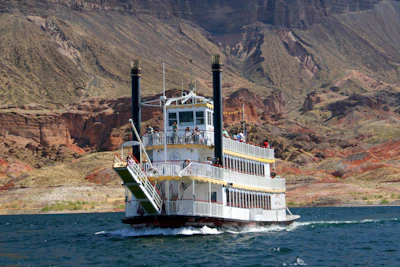
 Lake Mead Cruises has relocated docks and extended pathways to maintain guest safety and access amid ongoing water level issues, said company officials. Photo: Lake Mead Cruises
Lake Mead is a vital resource for Nevada, Arizona, California, and parts of Mexico, providing millions of people with drinking water, hydroelectric power and a wealth of recreation options. Yet, recent dry conditions and poor winter snowpack runoff has reduced the connecting Colorado River’s flow into the lake.
The Colorado River basin, which provides water to 40 million people, has lost 27.8 million acre-feet of groundwater in the past 20 years. An amount nearly equivalent to the full capacity of Lake Mead, according to a recent study by Arizona State University.
“Bath tub rings” near Hoover Dam are a stark indicator of how far water levels at Lake Mead have dropped. Kyle Roerink, executive director of the Nevada-based Great Basin Water Network, said it’s a simple case of water outflow not matching inflow.
“The metaphor is a bank account, where you’re spending more than you’re putting in, so you take on deficits,” said Roerink. “People must understand that the water cycle is changing. It all relates to water quantity at the end of day.”
A difficult adjustment
A searing southwest “megadrought” has dogged Lake Mead and its environs since the turn of the millennium. Regional recreation organizations have been consistently adapting to the diminishing waters, though not all tourists are thrilled about the changes, Roerink said.
“When the drought kicked in, there had been talk about jet boat trips from Leak Mead to the Grand Canyon, but that just can’t happen because the water levels are so low,” he said. “And all these side canyons are opening up with the water dropping, but some guy with a houseboat doesn’t care about a canyon. He wants his houseboat on the lake.”
Sediment left by receding waters creates a Mordor-like landscape of mucky river sand that makes boating and camping a challenge, said Roerink. Additional exposed surface area also has people venturing unchaperoned to areas not meant for rigorous exploration, he added.
“There’s been more search-and-rescue with people going to these places they shouldn’t,” Roerink said. “Lake Mead covers hundreds of thousands of acres, and people can get lost.”
Day, the Aramark Destinations official, said constant communication with guests, local governments and area businesses is more crucial than ever in maintaining public safety.
“Our plan is to remain flexible and adaptive to fluctuating water levels,” said Day. “Our long-term goals include investing in infrastructure, promoting sustainable practices and fostering community collaboration.”
A bit of creativity
With the retreating lake stranding campsites and other formerly water-adjacent assets, Lake Mead could potentially shift focus from water recreation to dry land activities. Roerink points to Glen Canyon – another prominent feature of the Colorado River system – now a popular site for hiking, cycling and off-roading.
Roerink envisions a future of helicopter tours, or paved roads and hotels where water used to be. In the interim, he is optimistic that even with current political divisions, the widespread impact of drastically falling lake levels will drive mitigation of the issue moving forward.
“No matter the political system, things will get done in the Colorado River system when push comes to shove,” said Roerink. “You’re dealing with 40 million people and a system that’s not just iconic, but represents American industriousness and the wild spirit in all of us. We will have to adapt.”
Roerink also advises Lake Mead businesses to accept the reality of a situation that may get worse.
“Humans can’t control nature, but that doesn’t meant your business won’t exist,” Roerink said. “The beauty of tourism and recreation is that it inspires creativity and ingenuity.”