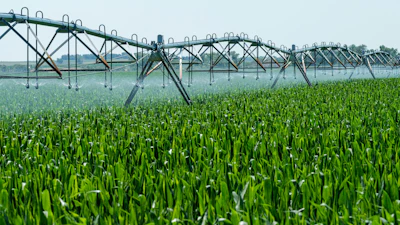
Facing a $69-billion infrastructure funding gap, wastewater utilities are finding new value in what was once discharged downstream: reclaimed water for agriculture.
All the while, outside funding for these initiatives has taken a hit. And if prevailing trends hold, the infrastructure funding gap could be $690 billion by 2044.
With all these variables in play, wastewater utilities aren’t just passing down costs to local utilities and customers to help balance the books. They’re seeking new revenue streams that provide financial relief.
One opportunity that falls under this umbrella is reclaimed water for irrigation.
Agriculture is a ripe market for reclaimed water
Around 60% of the world’s irrigated crops are grown in regions with high levels of water stress, according to the World Resources Institute. When demand starts outpacing supply, yields for critical crops are at risk, as well as the livelihoods of the farmers at the helm.
At the same time, global demand for water to irrigate crops is expected to rise 16% by 2050, as compared to 2019 levels. This is due in large part to rising temperatures, which cause crops to become thirstier and require more water to remain productive.
Now more than ever before, farmers need reliable and stable supplies of water.
Reclaimed water for irrigation provides that reassurance. With the right treatment, recycled water is a drought-resilient water supply that safely supports various crops.
Water quality and treatment requirements for agricultural irrigation
The EPA’s Guidelines for Water Use offer non-binding recommendations for the use of reclaimed water in agriculture. Leaving states with room to further define rules, the EPA’s framework recommends:
- Tertiary treatment for irrigating food crops consumed raw, such as lettuce, strawberries, or carrots
- Secondary treatment with disinfection for irrigating food crops (potatoes), orchards (apples and almonds), and non-food crops (cotton, flowers, etc.)
The federal guidelines also suggest typical thresholds for E. coli (<2.2 CFU/100 mL for unrestricted food crop irrigation) and turbidity (≤2 NTU as a daily average.)
In states like California, tertiary treatment and disinfection are required for the use of reclaimed water on any crop that may be eaten raw or come in contact with humans. The state also mandates continuous monitoring for turbidity and microbial content.
Texas, meanwhile, requires secondary treatment with disinfection for most irrigation uses. However, if spray irrigation is used on edible crops versus subsurface methods, there are tighter microbial standards to adhere to.
Wastewater utilities must stay up to date with local rules and tailor their treatment systems to these standards. That way, they can offer recycled water that is safe and applicable to a broader range of crops and irrigation systems, with the documents and reporting to support it.
The economics of selling reclaimed water for irrigation
As the demand for irrigation water grows, wastewater utilities can turn reclaimed water into a sustainable revenue stream.
The rates at which utilities charge for these services can tie back to a few variables:
- Treatment level: Utilities can charge a higher rate for tertiary-treated water that requires advanced filtration and disinfection, and lower rates when less processing is required.
- Seasonal demand: In California’s Central Valley, some utilities use seasonal pricing tiers. During the peak growing season, prices for irrigation water slightly increase to help offset increases in energy and maintenance costs.
Typical reclaimed water rates range between $0.05 to $0.50 per 1,000 gallons, and farmers often use millions of gallons of water per day in peak growing seasons. If a utility company offers a farmer 3 million gallons per day at $0.25/1,000 gallons, they could generate over $270,000 in annual revenue.
Direct revenue from selling reclaimed water for irrigation is only a fraction of the picture, though. There’s also value in the economics of a reliable, drought-resistant water supply to sustain the agricultural industry, as well as preservation of potable water supplies.
Successful partnerships between wastewater utilities and farmers
The Orange County Water District’s Groundwater Replenishment System (GWRS) in Southern California was primarily built to bolster the region’s drinking water supply. Some of the recycled water, however, is allocated to nearby citrus and avocado farms.
The partnership has reduced demand on traditional water sources in a region subject to drought pressures, while supporting the region’s $50+ billion agriculture.
In Arizona, the City of Scottsdale’s Water Campus produces highly treated recycled water that supports everything from golf courses to surrounding farmlands. Local farms growing water-intensive crops like cotton lean on this supply, especially in the hotter and drier months. The agricultural economy continues to thrive in the desert heat, while potable water supplies are preserved for residential and commercial use.
A growing opportunity in arid and semi-arid regions
Reclaimed water for irrigation is a sustainable strategy for wastewater utilities to recover value from treated effluent and strengthen the resilience of local agriculture. Nowhere is this opportunity more compelling than in arid and semi-arid regions, where rising temperatures and water scarcity are straining farmers and systems.
With thoughtful treatment, pricing, and partnerships, wastewater utilities can expand the reach of recycled water to more farms and fields, turning a growing challenge into a shared solution.