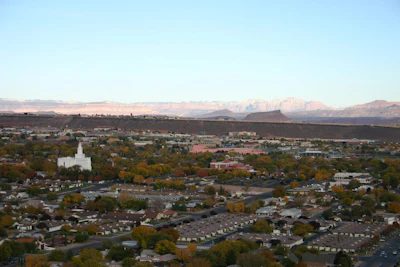

 St. George, Utah
In the American West, population growth is not slowing. But water supplies are.
As climate change delivers hotter temperatures and weaker snowpacks, utilities from major metros to smaller regional hubs are confronting the same math problem: demand keeps climbing while natural water sources are shrinking.
That’s why cities like St. George, Utah—one of the fastest-growing metros in the country—are betting heavily on wastewater reuse as the next essential pillar of water infrastructure. This shift is no longer theoretical. Across the West, recycled wastewater is evolving from a contingency option to a foundational source of municipal supply.
We found this recent NPR piece to be particularly strong when it comes to illustrating this dynamic. Here, we wanted to take a moment to draw out important business realities and implications from what’s happening in the ground in places like St. George and Las Vegas and elsewhere.
The tipping point: Wastewater is no longer waste
For decades, the question surrounding sewage was simple: how quickly can you get rid of it?
Today, utilities are flipping that equation entirely. St. George recently broke ground on a billion-dollar advanced wastewater recycling plant—an investment that would have been unthinkable for a city of 200,000 residents even a decade ago.
Zach Renstrom, general manager of the Washington County Water Conservancy District, put it bluntly: “All the water has been used. It’s been called for. But yet, we have one of the fastest-growing communities in the Western United States.”
The city’s current source, the Virgin River, has dwindled after a string of dry winters. Similar scenarios are playing out across the Colorado River Basin, forcing western communities to aggressively diversify supplies.
Following the Las Vegas model
For St. George and many other smaller cities, the template comes from their larger neighbors. Las Vegas has quietly led the wastewater reuse sector for years, recycling nearly all indoor water back into Lake Mead for credit against its Colorado River allocation.
Bud Cranor, with the Clark County Water Reclamation District, emphasized that this approach has enabled Las Vegas to double its population while stabilizing its net water withdrawals. The success of Las Vegas is reshaping how smaller utilities approach wastewater investment as a new growth enabler.
It’s often a policy matter, though. Technology isn’t necessarily the hurdle here; it’s upstream regulatory structures.
The mechanics of advanced treatment—filtration, biological processing, UV disinfection—are proven. What’s harder is aligning state regulations, permitting frameworks, public acceptance, and utility budgets to green-light direct potable reuse (DPR) or indirect reuse programs at scale.
In some jurisdictions, simply allowing greywater reuse for non-potable indoor applications like toilet flushing still faces regulatory hurdles that slow adoption.
Business implications for utilities and vendors
For utilities, the market signals are increasingly clear:
-
Wastewater reuse will become standard for growth-oriented communities.
-
New residential and commercial developments may soon require integrated reuse systems at the parcel or district level.
-
Utilities must design capital plans around long-term operational savings from reduced freshwater imports.
-
Vendor markets for advanced treatment, membrane systems, and decentralized reuse infrastructure are primed for expansion.
The procurement pipeline is already shifting. National engineering firms, membrane manufacturers, automation vendors, and digital monitoring providers are positioning aggressively for growth as municipal clients seek to build or retrofit reuse capabilities.
What comes next
St. George’s project is scheduled to come online later this year, joining a growing list of full-scale potable reuse systems coming online in Texas, California, Colorado, and Arizona. For many utilities, these projects are becoming new templates.