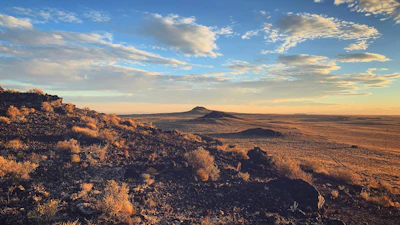
Jal is New Mexico’s southeasternmost city, a 2,047-resident enclave that shares a border with Texas to the east and south. Like much of the region, Jal is gripped by a harsh drought that has caused its surface water supply to nearly disappear, said Mayor Stephen Aldridge.
“We’ll get a little rain, then nothing,” said Aldrige. “It’s not a steady, predictable pattern, and monsoon season has been nonexistent the last couple of years. If you strike a match on the ground out here, it would burn to the coast.”
The answer to Jal’s water crisis could lie in its long history with the oil and gas industry – a literally groundbreaking initiative that repurposes treated wastewater from surrounding fracking operations.
Historically, fresh water was used in the Jal region for the extraction of oil and gas. The use of fresh water in frack operations has been replaced with “produced water” – a blend of underground saltwater and injected fracking water and chemicals. New Mexico’s fossil fuel sector produced a massive volume of toxic fracking wastewater in 2022, enough to inundate 266,000 acres with a foot of fluid.
Fresh water is already piped across Jal as a means of extracting vital underground resources. This process results in a byproduct called “produced water” – a mixture of original fracking fluid and groundwater brought to the surface alongside oil and gas. New Mexico’s fossil fuel sector produced a massive volume of toxic fracking wastewater in 2022, enough to inundate 266,000 acres with a foot of fluid. While the industry reuses over 85% of produced water in its operation, the rest is pumped into the earth.
Extracting oil and gas via hydraulic fracking requires enormous amounts of water – on average between one and nine million gallons for a single well. Produced water from New Mexico is typically piped to Texas and injected underground, a process recently associated with seismic activity.
In the meantime, both New Mexico and Texas have been actively pursuing produced water reuse, implementing a series of pilot projects on the viability of growing hemp, sunflowers and trees with produced water. Despite current state restrictions on using produced water in open environments, Aldridge recognizes the urgent need to secure clean water for Jal and its surrounding communities.
“If we’re going to diversify our economy, it’s going to take another water source,” Aldridge said. “That’s where produced water comes in.”
Finding a better way
Houston-based Aris Water Solutions is leading a multi-year project to repurpose billions of gallons of water in the Permian Basin – the largest oil-and-gas producing area in the U.S., spanning 66 counties in southeastern New Mexico and western Texas.
The Aris pilot, operated in concert with multiple oil and gas companies, is meant to drive down high costs typically associated with produced water clean-up. For example, thermal desalination treatment requires high energy consumption and the need for specialized equipment, said Aris chief scientist Lisa Henthorne.
Due to its heavy concentration of salts, chemicals and potentially toxic substances, produced water is considered waste until treated. The Aris process purifies this water using membrane or thermal desalination. Free of pollutants or radionuclides, the water is clean enough for industrial or non-consumptive agricultural use – later this year, Aris will begin growing non-food crops like cotton as part of a $10 million U.S. Department of Energy grant.
“The goal is to create a new water supply from very dirty water in a drought-prone part of the country, where an abundance of (produced) water can transform the whole region,” said Henthorne. “This is a very unique situation where there’s water available that has not been before.”
The high salt content of Permian Basin-produced water – three times higher than saltwater – poses a hurdle for Aris. Through the pilot, investigators will better understand how to filter out impurities like boron from a highly salty source.
“There’s not much literature for a lot of basic chemical interactions at these salinities,” said Henthorne. “We have to create a knowledge base on how these salts interact with different constituents.”
Education is key
Along with non-consumptive agriculture, treated fracking water could replenish reservoirs in drought-stricken areas like southeastern New Mexico, Henthorne added. A more dependable water supply could also draw industry to the area – markets with high water consumption include textiles and energy. Manufacturing sectors like electronics, meanwhile, harness water for cleaning and cooling delicate components in data centers.
For now, cost remains an issue for the widespread adoption of purified produced water. A barrel of desalinated produced water costs up to $2, a steep price for most industrial or agricultural needs. Ideally, continued experimentation with cost-effective processes will drive the “finished water” price down to $1 a barrel, said Henthorne.
Aris and its partners must also fight a public perception battle, though the potential for plentiful water has largely overridden concerns about its origins. To that end, Henthorne knows that education will be the key moving ahead.
“You seldom find folks impacted by drought who aren’t thrilled with the idea of a new water source,” said Henthorne. “We’ve got ranch families who are having trouble, so they’re enthusiastic about having water again.”
The “toilet to tap” concept – referring to reuse of treated municipal wastewater for drinking – has been another long-discussed solution to New Mexico’s scarcity problems. Yet, many residents find the cleanup of produced water more palatable, particularly for the revitalization of arid terrain, said Mayor Aldridge of Jal.
“There’s lots of uses for this water, like construction water for oil fields,” Aldridge said. “Even for regenerating some of the open land out here, which is in poor shape because of the lack of water. If you don’t have water as one of your top priorities, you’re on a fool’s errand.”
Aldridge is impressed with the Aris technology – he enthusiastically describes a crystal-clear fish tank on site, filled with treated water and populated by busily swimming fish. To sustain life in his parched corner of New Mexico, an innovative water recovery method is essential, he said.
“I remember my granddad telling me about rain – I sure am looking forward to seeing some myself,” said Aldridge. “The obstacle we have now is lack of imagination. We need to have a picture for what can be done. As we get more scale and scope (with the Aris project), we better understand the fit for produced water.”