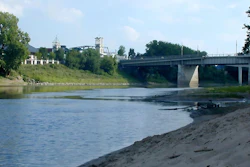
View of the Connecticut River in Old Lyme near its mouth at Long Island Sound.
Given its geography, it’s natural that water plays a sizable role in the lives of Connecticut residents. Native Eric Knapp remembers leisurely summers either spent along the coast or sailing the state’s numerous manmade lakes, while adulthood has brought the simple joy of romantic boardwalk strolls with his wife.
“Anyone in Connecticut will tell you that the prime things to do recreationally involve the lakes, Long Island Sound or the ocean,” said Knapp, a former attorney. “There’s also an arboreal forest, and you need rain to create that level of forestry.”
Connecticut boasts 3,000 lakes, ponds and reservoirs, according to its tourism website. Less publicized are the environmental changes reshaping the region, such as rising waters, drenching rainstorms, and other climate-related shifts that lawmakers and residents are reluctant to confront.
Knapp lives in Old Lyme, a town with 7,628 residents as of the 2020 census. Currently, he handles zoning and land use for his hometown, focusing on wetlands protection, floodplain management, and similar issues he addressed as a lawyer. During his childhood in 1970s Fairfield, Connecticut – which features five miles of shoreline on Long Island Sound – Knapp served as a lifeguard and generally utilized the system of rivers and lakes that flow through every community in the state.
Knapp also remembers the predictable weather of those bygone days, with regular snowfalls that started in late fall. In recent years, more intense storms have hit the region, with feet of snow falling at a time.
Then there are the “rain bombs” – sudden microbursts that can drop an inch or two of precipitation in an hour, leading to flooding. Last August, parts of Connecticut experienced historic flooding due to torrential rain, with some areas receiving over ten inches in a short period.
Knapp also points to the inexorable rise of Long Island Sound, a tidal estuary between Connecticut and Long Island. Sea levels around Long Island are projected to rise by two to three feet before century’s end, a slow-moving crisis that, left unchecked, will exacerbate coastal flooding and reshape the contours of Connecticut’s coast.
“It’s not dramatically higher yet, but there are lots of communities on the edge of the water,” said Knapp. “[A few inches] can make a big difference regarding someone’s street flooding during a full moon, or having water in the basement all the time.”
‘The water is coming’
Connecticut is ill-prepared for the imminent impacts of climate change on the region, Knapp added.
By 2030, significant coastal erosion will affect Old Lyme and other New London County municipalities, according to maps from the Federal Emergency Management Agency (FEMA).
Aging 20th-century infrastructure is another problem, with undersized culverts currently causing street flooding during heavy rainfall events. In addition, rising sea levels in Long Island Sound will lead to saltwater infiltrating Connecticut’s outdated septic systems.
“Even now, the nitrogen and phosphorus being added to the Sound due to the over-concentration of septic systems is impairing the water quality, impacting attempts at re-establishing shellfish beds along our shorefront,” Knapp wrote in an August 2024 op-ed.
Knapp told Water Daily that most residents are reluctant to fund any sewer system that would alleviate climate-driven shifts.
“People like the current septic systems, because there are costs for sewers,” said Knapp. “Old Lyme was talking about sewers 20 years ago, and the cost then was $20,000 for each house. Plus, putting in sewers allows for density in residency. We are low density at the moment, and people like that. It’s easy to use the lack of sewers to say, ‘I’m sorry, but you can’t build that development here.”
Knapp’s concerns extend to local industries powered by water. Increased ocean temperatures could affect the Millstone nuclear power plant’s cooling system, while elevated water levels would threaten the coast guard academy and a submarine base.
These problems will not resolve themselves, even as elected leaders worry about losing real estate taxes from at-risk neighborhoods, said Knapp.
“Things are going to get worse, and there’s no easy way to prevent it,” he said. “We need to start thinking about what the future will look like, because whether we think about it or not, the water is coming.”
A need to ‘create space’
Knapp’s current goal around the realities facing Connecticut’s shoreline is to “start a conversation.” As for possible solutions, elevating homes to protect from invading water is at best a half-measure. What the state can’t do is just construct an expensive seawall and hope for the best, he said.
“We cannot simply try and armor the coastline,” Knapp said. “And seawalls don’t reduce the energy of waves or the amount of water, they just divert them to another location. Any place that’s not armored will get more flooding.”
 Railroad Bridge over the Four Mile River’s mouth, which connects East Lyme to Old Lyme’s easternmost shoreline.
Even without breaching a wall, wave pressure can force underground water to the surface. Saltwater intrusion can also make tidal wetlands brackish by increasing their salinity.
Due to the persistent pressure of climate change, Connecticut will likely have to ‘create space’ by implementing housing buyouts and removing sheds and other hazardous structures from flood zones, said Knapp. Buffers around tidal wetlands may need to increase as well, though property owners will understandably chafe against any such encroachments.
“The money is behind the status quo,” said Knapp. “People don’t want to pay for schools right now, so how will we pay for [climate-related improvements]? This won’t be a quick problem to solve, and will require serious conversations with people whose properties will be lost. Politicians as a rule don’t like picking winners and losers.”
In that local op-ed published last year, Knapp emphasized that Connecticut’s response to rising waters must move beyond short-term fixes and embrace long-term, strategic solutions. One approach might be a buyout programs for at-risk homeowners, allowing properties to be converted into permeable land that absorbs floodwaters. Similarly, expanding buffer zones around tidal wetlands would help these ecosystems naturally migrate inland as sea levels rise, reducing flood risks for surrounding communities. Rather than relying on costly and ineffective seawalls, Connecticut could look to nature-based solutions, such as floating biomass mats and concrete reef balls, to dissipate wave energy and slow coastal erosion.
Aging septic systems are another major concern, as saltwater intrusion renders them ineffective and contributes to nitrogen and phosphorus pollution in Long Island Sound. Knapp suggested a shift toward small, community-based wastewater treatment systems, which would offer a more practical and scalable alternative to full-scale sewer installations. However, making this shift will require regulatory adjustments, including updates to health codes and zoning laws that currently limit the adoption of more adaptive wastewater solutions.
Finally, Knapp argues that proactive infrastructure planning is essential. Roads, drainage systems, and energy facilities must be designed with climate realities in mind rather than relying on outdated 20th-century models. Achieving this will require community engagement and policy action, ensuring that both residents and local governments acknowledge the need for change.
At the least, homeowners can build rain features, plant trees or install other porous surfaces to absorb or contain water. Knapp’s state can also explore more innovative solutions – Boston, for example, is running an “emerald tutu” pilot where a linked group of floating biomass mats help dissipate wave energy.
Knapp’s focus for now is on uniting people to consider possible solutions, whatever they may be.
“Let’s see what the science is showing and how we can address these problems,” Knapp said. “Have people think about the science, engineering and biology. I just want to connect people who aren’t talking to each other.”