
Columbus, Ohio, is in the middle of a major growth surge. The state capital is one of the fastest-growing cities in the Midwest, growing at a 1.0% rate—double the national average of 0.5%. Its surrounding areas are no exception.
While most of the city lies in Franklin County, a small portion of it falls in Delaware County lines, which is now the 22nd fastest-growing county in the U.S. According to the Central Ohio Population Resource Hub, the county’s population is expected to grow 85% by 2050.
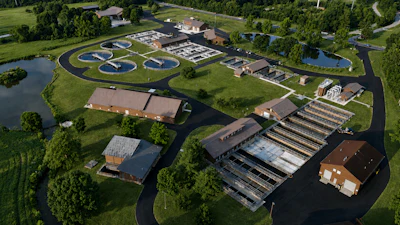
The growth is straining infrastructure across the board, but not more urgently than water systems. On Aug. 12, the county unveiled its $46 million upgrade to the Olentangy Environmental Control Center, boosting treatment capacity to keep pace with the flow. It’s a project other fast-growing utilities can learn from, both for the upgrades themselves and for the delivery method that made them possible.
“We’re planning for all the growth the county is enjoying and trying to do it in a way that’s cost efficient,” says Delaware County Commissioner Gary Merrell. “I think our rates are competitive compared to other counties in the area, and we’re proud of that.”
Getting the project off the ground
In 2016, the regional sewer district laid out the next 15 years of improvement—upgrading the wastewater treatment plant is a key part of that plan.
The plant was originally built in the 1970s, then expanded and upgraded in the late ‘90s. It’s the oldest of the county’s three treatment plants, and it had gone untouched for a good 25 years by the time the project began. Tiffany Maag
“We did a complete overhaul of the plant. We had a lot of upgrades and equipment that needed to be replaced,” says Tiffany Maag, director and sanitary engineer at Delaware County Regional Sewer District. “We also built a new screen building, because the previous plant didn’t have a dedicated screening facility at all. That’s extremely rare for a plant this size.”
Having a screen facility at the head of a plant prevents rags and debris from getting downstream and into the plant, which ultimately disrupts operations and contributes to equipment failure.
This particular project didn’t increase plant capacity, but it made the next phase of growth possible. All the county needs to do is add a few more aeration tanks and clarifiers when the time comes to significantly increase capacity.
Analyzing the upgrades
The plant needed to handle more volume without compromising treatment quality. In a conversation with Delaware Source, Operations Superintendent Jason Watts outlined the improvements that got it there: a new influent pump station, new filters, an automatic debris cleaning system, a control system to manage heavy flow, biological phosphorous removal, and a backup centrifuge that eliminated the need to rent expensive equipment during failures.
The last upgrade solved a problem the county had been dealing with for years.
Eliminating rental equipment concerns
Before the upgrade, county staff said it seemed like their only centrifuge would have a failure on Christmas Eve every year. In order to continue dewatering biosolids, the county needed to rent expensive dewatering equipment to keep the biosolids hauling process going while its current one was down.
“The existing centrifuge had to be shipped several states away for major repairs, which made the downtime even more critical,” Maag says. “Not having that redundancy was a huge issue for us.”
A major part of the upgrade was creating that redundancy to avoid a crisis when a centrifuge needs repair or even routine maintenance. Instead, the county can now rotate between two centrifuges when needed.
But not every part of the project went according to plan.
Managing bumps along the way
When the team decided to build a screen building, they originally planned to locate it on the North Parcel—which was recommended in the facilities plan. This would have been an expensive decision, as they would have had to dewater the land and excavate rock from the site. But that was only half of it.
“There was a bald eagle’s nest near the site and also a very real potential for archaeological artifacts to be recovered,” Maag says. “It would have been a major burden to try and build on that site.”
As part of the initial recommendations in the Progressive Design Build (PDB) process, the team scrapped the North Parcel and relocated the screen building on the existing plant property instead. Navigating that decision early on, Maag says, was one of the biggest high-level decisions the team faced. But by avoiding the cost and delay of building on a protected site, the county was able to direct that money toward other upgrades in the plant.
That flexibility didn’t happen by accident, it came from how the project was set up from day one.
Taking a closer look at Progressive Design Build
To pull off these upgrades on budget, the county turned to PDB—the first Ohio county to use the delivery method. It worked with local design-engineering firm Arcadis U.S., Inc. and Peterson Construction Company located in Wapakoneta, Ohio. The approach saved the county an estimated $12 million.
“The last several years have brought historic challenges to supply chains and material markets,” says Chad Dunn, project manager for Arcadis. “Using Progressive Design Build kept this project on time and on budget.”
Unlike traditional Design-Bid-Build projects, PDB has the design and construction teams working together from the start, rather than bidding out construction only once the design is finalized. According to the Lean Construction Institute, it typically unfolds in two phases:
- Phase 1: Designer and builder work in constant communication with the owner, refining the project until it’s on time, on budget, and meeting expectations. Then, a formal proposal is drawn up.
- Phase 2: The teams complete the project under that contract, with room to adjust terms if issues arise.
For Delaware County, that collaborative structure is what kept a complex, high stakes project on track. It’s a model other growing utilities might want to follow as they face similar pressure to expand capacity fast.