Hurricane Helene sent a strong message that if wastewater plants are to remain fully operational, significant thought must be given to their location within flood plains.
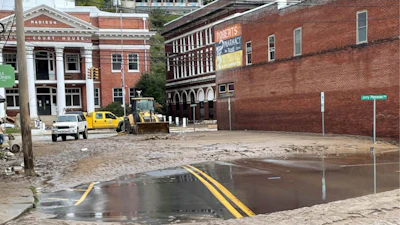
On Sept. 27, 2024, Hurricane Helene ripped through North Carolina’s western Appalachian region as one of the deadliest U.S. storms of the 21st century, with more than 100 confirmed deaths in the state as well as significant infrastructure damage.
In mid-April, North Carolina Gov. Josh Stein announced 66 projects in 26 counties statewide will receive more than $215 million in funding approved by the State Water Infrastructure Authority for drinking water and wastewater infrastructure projects.
Of those projects, the town of Marshall in Madison County will receive $4 million in Clean Water State Revolving Helene funds for its wastewater treatment plant relocation project.
Regarding where the new plant is being sited and factors influencing the decision, Marshall Town Administrator Ryan Cody notes, “We are working with FEMA to get all the approvals for this relocation,” adding there was nothing more on which he could comment.
A North Carolina Office of State Budget and Management Hurricane Helene Recovery damage and needs assessment report released Dec. 13, 2024, indicated the hurricane hit the state’s western region after it already had received substantial rain.
The additional precipitation brought on by Helene drove three-day rainfall totals exceeding eight inches across North Carolina’s mountain region and 12 inches in many areas, with the highest local rainfall maximums statewide exceeding 30 inches for the second time in recorded state history, producing 1,000-year flood events in several counties.
The electrical, gas, water, sewer, waste, and telecom infrastructure of western North Carolina services about 3 million residents and 500,000 businesses.
The area’s unique geography often requires pipes, wires, transmission, pumping stations, and related equipment span terrains uniquely susceptible to natural disaster and especially difficult to repair or rebuild, such as equipment traversing destroyed bridges or alongside high slopes and infrastructure spanning long distances to service low population density areas.
The area sustained $3.7 billion in damage to 163 water and sewer systems and hundreds of miles of impacted distribution pipes across more than 24 impacted towns in affected counties.
Of the 88 wastewater systems as well as hundreds of miles of distribution pipes impacted, four wastewater treatment plants, including Marshall’s plant, are partially operational or relying on backup power. One plant is without power; three are closed due to extensive damage.
Noting construction costs have risen significantly since COVID-19, other factors influencing the financial impact focus on multiple recovery efforts from concurrent natural disasters across the Southeast that may lead to higher-than-normal costs than for disaster recovery.
This unprecedented damage and impact to the state have led to calls for strengthening and mitigation to prevent future disasters of this magnitude.
The Marshall wastewater plant sustained significant impacts.
“Flood water completely submerged the existing wastewater treatment plant facility for approximately 24 to 48 hours, with water reaching the second floor of the operations building,” says Cathy Akroyd, spokesperson for the North Carolina Department of Environmental Quality Division of Water Infrastructure.
“Nearby Blannahasset Island was completely submerged. The access bridge was severely damaged,” she says.
Addressing why relocation was chosen instead of repair, Akroyd points out “to be prepared for future storms, it’s important to relocate the plant out of the floodway and flood plain. The new plant will be out of the floodway and out of the 500-year and 100-year flood plains.”
Akroyd notes the project will take a few years to complete, beginning with design before construction begins.
While the plant is operational and up and running it’s not a permanent solution, Akroyd points out, adding the plant does not have all functionality or optimal performance.
“The wastewater treatment facility is currently operating off temporary measures for sewer treatment and needs permanent solutions to fully recover the town of Marshall' s sewer system as it was prior to the storm event,” she adds.
“For resiliency purposes, several plants are being moved out of the floodplains to prepare for future storms. One hundred of project construction costs for the proposed project will directly replace, relocate, and improve the resiliency of infrastructure that sustained heavy damage due to Hurricane Helene.”
Akroyd notes all western North Carolina counties with Hurricane Helene impacts were encouraged to send in applications to the North Carolina Department of Environmental Quality Division of Water Infrastructure for drinking water/wastewater infrastructure projects producing resiliency for future storms.
The Division of Water Infrastructure’s priority rating system was used to determine eligibility and rank projects. Selected projects were approved by the State Water Infrastructure Authority.
“Marshall’s projects clearly address resiliency and were selected based on this approach,” says Akroyd.
In addition to the $4 million wastewater treatment plant relocation project awarded in April 2026, Marshall was awarded two additional Hurricane Helene-related projects in December 2025: a $5-million project for the plant relocation as well as a $10-million drinking water resiliency improvement project.
Akroyd says as design and construction phases occur and costs are incurred, towns and cities send invoices to the Division of Water Infrastructure.
Noting that the State Water Infrastructure Authority/Division of Water Infrastructure has funded a total of $9 million toward the Marshall project, Akroyd says the town will need to secure additional funding for the $30 million project.
Additional infrastructure to be improved as part of this project includes the Redmon Road, Rollins Road, Bailey's Branch, and Island Road pump stations, which sustained heavy damage from the storm and experienced flooding that submerged critical electrical equipment and control panels, Akroyd notes.
“Pump stations in the town's collection system sustained heavy damage from the storm and will be fortified against future flooding as part of this project to strengthen the system's protection and reduce the risk of catastrophic damage occurring in the future,” she says. “These improvements include replacement equipment where necessary, rerouting and fortification of force mains, and the installation of new permanent backup generators at each pump station, which currently do not have permanent backup power.”