South Adams County Water and Sanitation District (SACWSD) is under construction for one of Colorado’s largest ion exchange (IX) treatment plants to treat PFAS. The $80-million Klein Enhancement Project will include pretreatment with nine 9-micron cartridge filters and core treatment, including “seven IX treatment trains, a 375,000-gallon equalization tank, and six vertical turbine pumps to feed the IX trains from the District’s 13 groundwater supply wells,’’ according to a release from Brown and Caldwell.
SACWSD is Colorado’s largest combined water and sanitation district, located just outside of Denver and serving a population of 70,000 in Commerce City. SACWSD found elevated levels of PFAS in 2018 when they began voluntarily testing the raw water supply.
Since then, SACWSD began taking steps to ensure the PFAS levels were below the EPA standards, including ceasing drawing from the most impacted wells, purchasing treated water from Denver Water to blend into the supply, and purchasing lab equipment to test levels on site.
In 2021, they partnered with Brown and Caldwell to design treatment solutions, ultimately choosing the IX treatment plant. In 2023, PCL Construction, Inc. was chosen as the construction manager under a Construction Manager at Risk (CMAR) delivery method, allowing them to come in early at 30% of design so they could work with the engineer and owner and provide construction feasibility, value engineering, reliable scheduling, risk management, as well as cost certainty.
That was the focus of a presentation held at the 18th annual Rocky Mountain Section American Water Works Association (RMSAWWA), A Collaborative Approach to PFAS Treatment, led by Jamie Safulko, Area Manager and Scott Colvin, Construction Manager, PCL Construction, where the team outlined some of the benefits the CMAR approach granted for a project of this size and complexity.
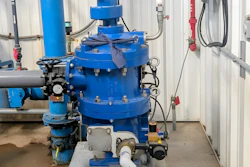
 The pump gallery before the pumps are connected to the piping. Photo courtesy of SACWSD.
Risk mitigation
All projects have risks, but the collaborative approach allowed the entire team—contractor, owner, engineers, and trade partners/subcontractors—to participate in creating a risk register to identify potential risks, assess likelihood, identify mitigation/management tactics, and the cost associated.
Among some of the risks identified, the team worked to solve, long lead times on materials that cause schedule creep, meeting Buy America, Build America (BABA) requirements for grant money received under the Bipartisan Infrastructure Law funding, and location challenges including ensuring no interruptions to current operations and as little impact as possible to public as well as strong communications about the project.
Early team development and procurement packages
Early involvement of PCL Construction meant key subcontractors could be brought in early to help determine the appropriate electrical gear and value engineering. This coordination with subcontractors provided better schedule reliability. “It helped ensure there were no issues with coordination, and people knew when they needed to be here,” Colvin said in an interview with Water Daily.
A list of materials and equipment with long lead times was created ahead of time so that early procurement packages could be put together at 60% of design. Colvin explained that for things like the backup generator, electric gear, vertical turbine pumps, the actual PFAS ion exchange equipment, as well as potentially long lead time items, were included. “That way, when we went to construction, materials would already be at the job site,” said Colvin. These steps helped expedite project delivery and eliminate surprises that can cause schedule creep.
Funding
The Klein Enhancement Project was approved for $61 million in federal grant funds through the Bipartisan Infrastructure Law, which required BABA compliance.
There were some concerns early in the project that the domestic requirement could cause price escalation; however, because PCL Construction was involved so early, it allowed for upfront efforts to investigate BABA-specific items to ensure they met compliance requirements and fit the cost expectations.
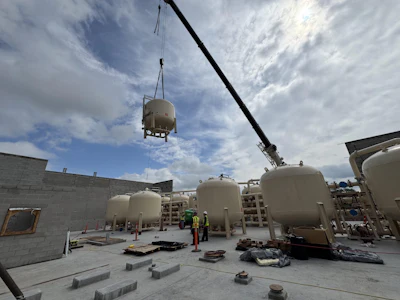
 Setting the filter vessels. Photo courtesy of SACWSD.
Colvin noted, “If there was something specified in the design, and our research determined it wasn’t BABA compliant, we had time to investigate another vendor, manufacturer, or whatever the case may be to ensure we met the requirements and not have that extra research affect our schedule.”
Communications
Communications with the public were important to SACWSD. Town halls took place early in the design phase, and PCL was able to add support to the SACWSD communications and an additional layer of information to the public once on board. Before the project broke ground, door hangers were distributed around neighborhoods impacted by the construction.
In addition, SACWSD held an open house recently that allowed the public to tour the existing facility and see the progress on the new IX treatment facility. Roughly 100 people were in attendance. PCL was also in attendance to help answer questions. “It’s a great way to educate the public, show where their water is being treated, and get more public engagement,” Colvin said.
To date, the Klein Enhancement Project is running roughly four months ahead of schedule and under budget. He attributes this to the early involvement of all parties and the collaborative nature of the team. The ability to brainstorm construction ideas together meant they could deliver quality, build it safely, and make sure the price was right.
“It’s been a very cohesive team,” Colvin said. “I can’t emphasize enough, the collaboration team effort between us, the owner, and the engineer.”
As far as using a CMAR approach, Colvin noted it’s a shift in mindset from the traditional design/bid/build. Because the design/bid/build approach has multiple bidders, there is a perception of value, but he says that CMAR is still competitive and involves negotiation. In addition, early collaboration adds an extra layer of value because it greatly reduces unknowns that can cause price increases and schedule delays. “What I enjoy is that the approach gets buy-in from the overall team,” said Colvin.
The Klein Enhancement Project is scheduled to be completed in late 2026.