Hot Sulphur Springs, Colo., celebrated the installation of a BOLLFILTER system after a harrowing battle against increasing turbidity in the Colorado River.
The challenges began nearly five years ago, after the East Troublesome Fire in 2020 burned a large portion of the upstream forest.
“A lot of the ash wound up coming down the river and clogging up the intakes,” said Michael Gramm, the town’s Public Works Supervisor.
In the following years, heavy rains and runoff over the burn scar, compounded by upstream reservoir renovations, caused varying sediment loads, requiring multiple stopgaps until a permanent solution could be implemented.
The challenges peaked in 2021, when the town was forced to overcome two scenarios where the sediment buildup was so high that, in one instance, they needed to bring in rental equipment for 30 days at a cost of $78,000 and, in another, the entire intake system was shut down for roughly 24 hours.
In both cases, the town did not run out of water or suffer any water quality issues. “You know, honestly, I think people were aware that there was a lot of work going on down there, and the guys were really busy trying to make the water,” said Katie LaDrig, Town Clerk and Treasurer. I’m not sure if they realized how badly we had been affected, because they did such a good job.”
Even after the record rains of 2021, the town continued to face turbidity issues. “Operators were constantly blowing out raw water intakes to get the flow stabilized. It could be three to seven—sometimes even eight—times a day to get the flow manageable to operate the water plant,” said Gramm.
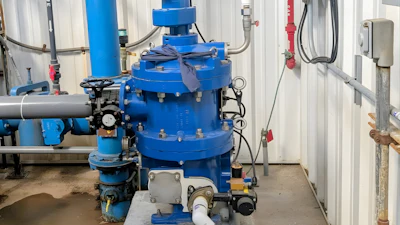
By 2023, Phillip McElroy, the water plant operator at the time, suggested the BOLLFILTER system. In addition to pre-filtering water before it enters the membranes, it has a backwash cycle that prevents clogging by flushing out accumulated debris. “It’s essentially an automatic backflow strainer system, so we didn’t have to constantly shut down the plant,” said Gramm.
 The BOLLFILTER installed at Hot Sulphur Springs’ facility.
By September of 2024, the new BOLLFILTER system was fully operational. Gramm said, “It’s been phenomenal. The health of our microfiltration membranes has been far more stable than prior to the installation, so it was a good investment.”
Funding
The final project cost was $143,000. “We didn’t think it was going to be as expensive as it ended up being,” said LaDrig. The project was funded in part by Colorado’s Department of Local Affairs Energy/Mineral Impact Assistance Fund grant, in addition to $25,000 approved by county commissioners which helped offset the cost. In the end, the town needed to pick up roughly half the cost.
To help pay for the expense, water and sewer rates were raised 20% in 2024. After that, strict budgeting and smart negotiating were necessary. “We tightened our belts. There were no raises or cost-of-living increases for a year and a half, and we cut way back on anything we felt was unnecessary spending,” said Mayor Ray Tinkum.
In addition, LaDrig worked with vendors to spread out payments. “I remember calling vendors and saying, ‘Hey, I don’t have all the money for this. Can I make payments to you?’ And they were wonderful about working with the town.”
The future
Even after conquering the turbidity issue, the Public Works Department has challenges to overcome. “We’re constantly chasing more upgrades and more repairs because it’s an ongoing system that’s going to fall into disrepair if you don’t keep up with it,” said Gramm.
The largest project to fund is the replacement of a lagoon liner at the wastewater treatment facility. The price tag is projected at $1.8 million.
Hot Sulphur Springs is on the list of requests for Community Project Funding from Congressman Neguse’s office, but not all requests receive funding, and the outcome is uncertain at this point.
“We have to do the same kind of work in treating the water, but the financial part of it has to be spread out through a much smaller user group,” said Tinkum. “We’ve figured out a plan to make it work.”
The town has scheduled a public meeting to notify the community. “We’re going to go after that loan of $1.8 million, and it’ll be a 30-year loan with a little over 3% interest,” said Tinkum. “We finally came to the realization that this is going to have to be a commitment out of pocket to the town for the next 30 years.”
Like many small towns facing the steep costs of infrastructure upgrades, Hot Sulphur Springs continues to look for and find solutions. “We never give up,” said LaDrig.