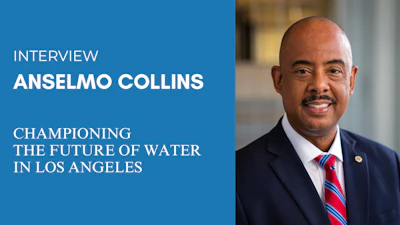
As the Senior Assistant General Manager of the Water System for the Los Angeles Department of Water and Power (LADWP), Anselmo Collins is at the forefront of LA’s sprawling water system. Earlier this year, he won the Advocacy Achievement award from the WateReuse association for his work on projects like Pure Water Los Angeles, an initiative which seeks to transition Los Angeles’s water supply from being 50% local to 70% using advanced purification systems centered around water reuse.
I talked to Collins to gain insight into LA’s bold moves to become a more independent water system, how climate change has modified California’s water practices, and the role of advocacy in the water industry.
Ryan Vincent: You’ve been in this industry for over 30 years. How did your journey into the world of water infrastructure start?
 Collins
Anselmo Collins: Oh boy… I’ve been working in the water industry for 34 years. I actually started out as a student engineer here at LADWP for two years, got hired on full time, and I’ve been here ever since.
When I went to college and studied engineering, I always thought I was going to be doing more construction work, heavy civil-type work, but I was able to get an internship here at the department when I was still in college and that sparked my interest in the water industry. Ever since, I have been in the water industry and I love what I do, so it’s an honor for me to be in the position I have now and to lead one of the largest municipal water systems in the whole country.
Vincent: You won the Adovcacy award from WateReuse earlier this year—what was your reaction to winning it?
Collins: You know what, I was surprised and I was humbled, because I know that there are a lot of agencies out there that are working on water reuse… so to be selected to receive that award, I was very humbled. I was able to see some of the people that received it before me, and these are the elite when it comes to water reuse in the country. To be given that opportunity to receive the award—I was priveleged and very humbled and honored by it.
Vincent: Thinking about advocacy, water and power are both things that every person in the US interacts with on a daily basis—what is there to advocate for within an industry everyone utilizies daily?
Collins: There’s a lot, actually. You’d be surprised. Obviously there’s a lot of advocacy that we have to do when it comes to getting funding for these projects. When you talk about water reuse, one of the biggest challenges is that it is not cheap. No new source of water is cheap, necessarily, but we have to do these projects because of climate change. We’re in a situation where there are years where you may have extreme droughts, and we want to be able to sustain the city by providing water when it’s needed. We embark on these projects that are innovative, and they provide us resiliency, reliability, and sustainability to the city. But getting federal funding and state funding to be able to execute these projects and not put the entire burden on the backs of our rate payers, is very important. To me, when you’re doing advocacy, you’re talking about that. Also, in California, a lot of advocacy work was done in developing the regulations for Direct Potable Reuse.
Vincent: Can you talk a little about water reuse?
Collins: When you think about water reuse, traditionally, people think about it as using the water for irrigation, for example. Well, we took the next step, which is indirect potable reuse, where we’re putting the water in the ground to recharge groundwater basins to use it later. Now, California is taking the next step. Now we have regulations that have been set to allow us to do direct potable reuse.
When you look across the nation, for different reasons, everyone’s got some kind of reuse project. In California, obviously for us, we are subject to climate change. We’ve had that climate whiplash that you’ve probably heard about before. We just got out in 2022 in one of the most significant droughts in history. It was so difficult that in 2022, our wholesaler, which is the Metropolitan Water District, could not buy the water from the state to serve us because the state did not have it.
That really hit hard with me, because what it told me is that we need to continue to push and push hard for reuse because it is far less climate dependent than importing water from hundreds of miles away…The city gets water from its own aqueducts, but we can buy water from the Metropolitan Water District—that water’s coming from the State Water Project—and we can also get water from the Colorado River aqueduct. All of those sources of imported water were stressed during the drought. For us, we have been investing in and developing local water supply projects.
The biggest challenge is going to be funding because of the demand of these projects…But when I think about the cost of the projects, I compare it to the cost of not having water. The assumption people made in the past is that if you don’t have it, you can buy it from somebody. Not necessarily. We want to make sure we support the vitality of the city of LA, so we have to advocate for funding and regulations that would allow us to implement these projects.
Vincent: You’ve talked a bit about climate change’s effect on LA at large. According to the LA County of Public Health, if the world continues warming on its current trajectory due to climate change, central Los Angeleles and other coastal areas could see three times as many more days with temperatures over 95 degrees. How does climate change and its effects in California factor into your decision making as Senior Assistant General Manager of the Water System in LA?
Collins: You know, climate change has a lot to do with a lot of the initiatives that we have in the center of LA. I mentioned the local water supply. For us, local water supply has several components: conservation, for one. We lead the way when it comes to conservation in the region. We are to the point where our customers use around 104 gallons per person per day. If you had looked at that same statistic thirty years ago, it was closer to 200. It’s reduced significantly. As a matter of fact, in LA we use less water today than we did 50 years ago despite the fact that there’s a million more people living in Los Angeles.
The other thing, too, is when you talk about climate change, you’re going to have drier dries, and wetter wets … I can tell you that we’ve had very dry years here in LA, but we’ve also had some really crazy wet years. 2017 was one of the wettest years in history. There was more water that was coming down our aqueducts that we could actually move… There was so much water that we had to spread some of that water away from the aqueduct and recharge some of the basins there so we wouldn’t overwhelm our aquedcuts. That tells you how we’ll go from one extreme to the other.
You go from feast to famine pretty quickly, and the job that we have as water managers is to manage the two extremes.
The other thing too, for us, is we are an area susceptible to earthquakes, unfortunately. The three aqueducts that bring water to the city of Los Angeles all cross the San Andreas Fault. It’s not a matter of if, it’s a matter of when we have another quake that is strong enough to potentially damage the aqueducts. Having local water supply, having a reuse program that is producing water locally, is going to allow the region to really be able to be supported while these aqueducts are potentially being repaired. It all relates to our sense of resilience, but also climate change.
Vincent: Over the course of your career, have you seen climate change affect the operation of your job? Is it different now than it was years before?
Collins: Oh absolutely. When I first started my career, we were focusing a lot on building infrastructure projects, dealing with water quality regulations, and making sure that we comply with everything… Right now, a lot of the focus that we have is in building these local water supply projects. It is not just LA doing this—it’s everybody. The reality is that the only way we’re going to be able to really develop a system that’s climate resilient, is going to be for us to work as a region. That’s probably the biggest change. Developing projects that can be interconnected gives us a regional reliability that I think we all need. If LA is able to build projects and have enough water during a drought, but the neighboring city cannot, that’s a problem.
The southern California economy is one of the largest economies in the whole world, and for us to sustain that economy so businesses can continue to thrive and people can continue to live here comfortably, we have to work together… I’ve seen a lot more collaboration amongst agencies to work together because we also recognize that, by all of us working together, you can take that cost and spread it across a larger customer base. Everybody is contributing, and everybody has more resilience and reliability.
Vincent: It seems like a lot of the work you do involves other agencies and organizations, like with the Owens Lake Dust Mititgation Program, or how Pure Water Los Angeles is a collaboration between LADWP and LA Sanitation. In your role as a leader, how do you go about navigating inter-organizational challenges?
Collins: I’ll tell you, you’re very right. One of the things when we talk about reuse is that there’s no single agency that can do it by themselves. As a water purveyor, I need to work with our wastewater agency and the city of LA. We have to work with [LA Sanitation] so they can take the water, treat it at a certain level, and then provide it to us…Right now we’re working with LA San on the Donald C. Tillman Water Reclamation Plant. It’s a groundwater recharge program where we’re taking the effluent, we’re treating it to a higher level, and we’re going to be able to reuse… We’re looking at 25 million gallons per day currently. Once we finish, we’re potentially going to expand the plant up to 40 million gallons per day of advanced recycled water that’s going to be used for groundwater recharge.
When it comes to partnerships, for us, our sanitation folks are our biggest partner, but we also have to partner with the groundwater basin managers. For example, we have the central basin and the west coast basin, those are managed by the Water Replenishment District. We’re collaborating and working with them because, as we develop Pure Water Los Angeles, we want to be able to put that water into the ground and add to that basin there. I would say that collaboration is probably the most important thing.
In southern California, I’ve mentioned before our wholesaler, the Metropolitan Water District. They are also working on a reuse project called Pure Water SoCal. One of the things that we’re talking about is having interconnections between their system and our system so that in years when perhaps we have a lot of water because of a lot of precipitation… we can potentially send some of that water to them to store in basins that I don’t have direct access to, but it benefits the region.
Vincent: What about collaborations outside of water-based companies?
Collins: The other important thing I will say about partnership is about workforce development. With direct potable reuse, we’re developing new requirements to have advanced recycled water treatment operators. We’re going to need a lot of new operators, we’re going to need a lot of mechanics, electricians, people that can build these facilities as well as operate and maintain them. This is an opportunity that we have now to basically develop a new workforce for the city and for the region. But if we can do it in a collaborative fashion, it would be even more impactful.
We’ll need to collaborate with other agencies, collaborate with the county, eventually collaborating with school districts or universities to perhaps offer some of this training. This will open up the door to people who would like to be in the water industry and we could provide them with an opportunity to get an education, then qualify for these jobs. We would love to be able to target the disadvantaged communities, where you have people either unemployed or underemployed who are looking for a change—now we can give them a pass to the middle class by having these great jobs that help bring water to the city, but also improve their lives because they’ll have good paying jobs.
Vincent: So common projects among many places in California right now centers around reuse or local water infrastructure. Are there any problems or challenges in the Los Angeles water system that you see as unique or special to the area?
Collins: The most unique thing for us is that our water comes from really far away. It’s a challenge to be dependent on water that’s coming from hundreds of miles away. I think that, for us, the challenge that we’re going to have and have right now is that there’s so many of these programs being implemented, we are all competing for the same talent that’s out there. We’re developing our program, the Metropolitan District is developing [Pure Water SoCal], the city of San Diego has a pure water program, Las Virgenes Municipal Water District has their water program.
We have a pretty large number of skilled employees that everyone is competing for. We are straining, quite honestly, that pool of candidates because we have a bigger need than we have resources. That’s why I talked about resource development because we need more staff and more contractors and consultants than perhaps the market has. In LA, we’re also competing with, for example, if there’s any contractors working for the [2028] Olympics. We have some pretty big events that are taking place in Southern California. We all compete for talent at the same time. Developing this pool of new staff and workers is something that’s a challenge, and the way we’re going to meet it is by collaborating on the workforce development programs.
Vincent: Do you think that sort of collaboration between agencies and universities is something other districts across the country could benefit from?
Collins: I think so. I think there’s other areas that have done a really good job on developing this sort of integrated approach to workforce development and we can learn from them. But as we develop our Pure Water projects throughout the region, that will hopefully be a blueprint that can be used as a template for other regions to do it.
Vincent: Do you have any advice for people in similar leadership positions, or just generally for those working in the world of water infrastructure right now?
Collins: My advice would be that people need to really focus on collaboration and partnerships. That is very important. Nobody can work on these types of programs themselves, and whenever you have the opportunity to work on a program that provides a regional benefit, it brings more people to the table. It also allows people that don’t have a big voice because they might be representing a smaller city to still benefit from it.
That spirit of collaboration also spurs innovation. When you look at the water industry, with everything that’s happening with recycled water and that’s happening with treatment technology in general—we need to embrace technology and innovation more. We can learn from other parts of the world, too. When you look around the world, there are places that have implemented direct potable reuse or other types of programs that are quite innovative, and taking the time to talk to those people and understand how they implement it, is a way for us to be able to implement our projects better and faster because we’re not reinventing the wheel.
In the water industry, there has always been this sense that we’re all working together, not competing against each other, but I think we still need to make a bigger effort to embrace new innovations and to be really comfortable in engaging with others and bringing others to the table so we can all work together on the important projects.
Vincent: Makes sense to me. Now, it’s been established how busy you are with a multitude of projects from within LADWP and beyond, but what do you like to do in your free time?
Collins: You know what, I was going to say play golf, but I’m not very good at it. I pretend to play golf whenever I get the chance. I like to spend time with my wife, doing some wine tasting as well. California has beautiful wineries, and they use water so it’s a way for me to test one of the applications of our projects.
So it’s all work related.
Collins: Exactly.