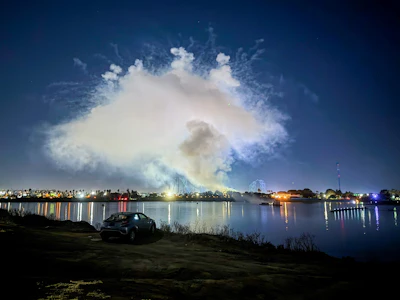
 Two San Diego environmental groups have filed a lawsuit to reduce the number of fireworks shows put on by SeaWorld. Photo: Natalie Clagett
Fireworks have long been lighting up summer skies with gorgeous color. In San Diego, this spectacle of sound and light has a price. According to two regional environmental groups, fireworks debris from SeaWorld is now a major source of pollution in Mission Bay.
In March, San Diego Coastkeeper and the Coastal Environmental Rights Foundation filed suit against SeaWorld, claiming the company violated the federal Clean Water Act by not cleaning up debris from its nightly fireworks shows.
The lawsuit derives from an investigation launched by the two groups, which included sending a diver into the water near one of SeaWorld’s fireworks barges. The search of the bay’s bottom revealed a variety of related litter, namely metal wiring, cardboard and plastic shell casings. Similar trash has also been discovered along the shoreline at low tide.
Meanwhile, water testing has shown elevated levels of barium and strontium, chemicals used to create the vibrant colors in fireworks. The 40-page lawsuit alleges that the company has neglected to perform post-show cleanups as required by both the Clean Water Act and the park’s own permit, while discharging poorly treated wastewater into Mission Bay.
SeaWorld is supposed to be following a fireworks permit established by the San Diego Regional Water Quality Board, which prohibits “the discharge of residual pollutant waste to waters of the state in a manner causing, or threatening to cause a condition of pollution, contamination or nuisance.” Per the suit, the marine theme park has failed to collect toxic trash in waters around its fireworks barge, a task encompassing both shoreline cleanup and a comprehensive clearing of the bay.
 “We are asking for a transition from fireworks to drones, which is a proven technology that provides similar entertainment,” said Phillip Musegaas, executive director of San Diego Coastkeeper. Photo: San Diego Coastkeeper
“The permit set requirements for how SeaWorld was monitoring water quality and doing annual cleanup of the bay floor,” said Phillip Musegaas, executive director of San Diego Coastkeeper. “We started to look at that, and heard from the community about trash washing up. SeaWorld seems to be disregarding the permit, while the (water quality board) hasn’t been enforcing it.”
Firework remnants can entangle marine life, with fuse caps and other non-biodegradable components persisting in the environment for years. This pollution further threatens coastal ecosystems and recreational activities, added Musegaas.
SeaWorld, which declined comment for this story, responded to the suit with a court filing that denied the multiple alleged violations against its operations.
“SeaWorld acted with due care, complied with all statutory and regulatory requirements and industry standards, including with respect to its obligations under the Fireworks Permit and Wastewater Discharge Permit, endeavored to comply with the Clean Water Act, took all required or appropriate precautions and otherwise conducted themselves reasonably under the circumstances, and SeaWorld, therefore, cannot be held responsible for the harm alleged in the Complaint,” the filing said.
Finding an alternative
The park’s permit allows for up to 150 fireworks shows annually, although that number has recently dropped to around 85 due to community opposition, noted San Diego city council president Joe LaCava.
Many residents find the noise from the fireworks to be as much a nuisance as the debris polluting the bay, LaCava said.
“You can set your clock during summer when the fireworks are going to go off,” he said. “So that’s a big impact on animals, especially dogs. This has been an ongoing conversation for years.”
In 2024, animal rights activists attributed a rise in bird deaths in the bay to Fourth of July pyrotechnics, a claim that has not been proven. Still, LaCava, who represents District 1 and the north shore of Mission Bay, said the lawsuit against SeaWorld underscores the need for more sustainable alternatives.
Between 2017 and 2020, SeaWorld substituted some of its fireworks shows with drone and laser displays. This experiment ended with a complete return to nightly fireworks programming, according to Coastkeeper officials.
LaCava would like to see more drone light shows in the future – a nod toward the environment as well as people with certain sensory sensitivities. The council president pointed to La Jolla as one San Diego community that has successfully substituted fireworks with drones.
In the interim, LaCava has had “productive” conversations with SeaWorld San Diego officials about the fireworks, but the final decision on programming will ultimately come from the park’s Florida headquarters.
“Litigation puts a spin on (those talks), but there’s a willingness to engage in conversation, and have an understanding about how residents are changing their attitudes (about fireworks),” LaCava said. “There are also people who defend the shows, saying it’s an American tradition.”
Coastkeeper official Musegaas is aware of how the lawsuit may be perceived in today’s political climate, particularly by those who might view reducing fireworks displays as anti-American. Backlash will not stop the suit from going forward – not when a vital coastal waterway is at stake, he said.
“The goal is to protect the natural environment in Mission Bay, as well as the communities nearby,” Musegaas said. “We are asking for a transition from fireworks to drones, which is a proven technology that provides similar entertainment. It’s time for SeaWorld to move into the future and eliminate these impacts.”