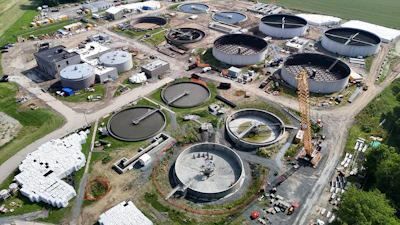
 Construction at the Milton Street wastewater plant will double treatment capacity for the Chemung County area. Photo: Chemung County
Chemung County, New York, is in the midst of a $275-million infrastructure upgrade to combine two aging wastewater treatment plants, a move designed to protect water quality for the Chemung River and its connected watershed.
The funding needed for this ambitious endeavor has already been obtained by county administrators. Thanks to an aggressive grant writing approach, Chemung County has successfully obtained over $72 million in grants and $22 million in zero-percent interest hardship loans for the consolidation project. Grants will cover 26% of project costs, with the remainder financed through additional low- and zero-percent interest loans.
For these efforts, the county was awarded the EPA PISCES Award for Excellence in Innovative Financing by the U.S. Environmental Protection Agency. Officials accepted the award in April at the 2025 Council of Infrastructure Financing Authorities summit in Washington, D.C., where it was one of 22 projects recognized.
Along with grant dollars, the county acquired $200 million in federal aid from the Bipartisan Infrastructure Law (BIL) and New York’s Water Infrastructure Improvement Act (WIIA) grant program.
Funding from the BIL and WIIA programs encompasses more than $75 million in short-term interest-free funds, $75 million in short-term market-rate funds, $22 million in long-term interest-free funds, along with a $25 million BIL grant and $25 million WIIA grant.
The funding for the project is allocated for the planning, design and construction required to merge the two wastewater treatment facilities into a single, consolidated treatment plant. By proactively securing infrastructure funding, Chemung officials expect to reduce the overall financial burden from this project on sewer users by roughly $100 per year.
Annual sewer costs have increased as the county pays down the debt from the loans that funded the initiative. However, Chemung County Sewer District rates of $507 per year are still below the $600-$800 average paid by surrounding municipalities, note officials.
“We are a hardship community with a $43,000-per-year median income in the city of Elmira,” said Alexandra Rennie, executive director of sewer districts with Chemung County. “We knew we had to pursue every grant opportunity for this project.”
Meeting a need
Now in its fourth year of construction, the wastewater initiative will merge the Milton Street and Lake Street plants – the over 60-year-old Lake Street facility no longer meets effluent discharge standards, posing a pollution danger for the Chemung River and connected Chesapeake Bay Watershed. All facility upgrades are expected to be completed by Sept. 2026, said Rennie.
 Construction at the Milton Street wastewater plant will double treatment capacity for the Chemung County area. Photo: Chemung County
Though both plants are outdated – the Lake Street plant dates back to 1962 and Milton Street to 1987 – the Milton Street location is more suitable for renovation because its original design allowed for expansion of existing treatment processes. In addition, large concrete wastewater tanks at Milton Street can be reused without any major overhauls.
A 2018 Chemung County study confirmed the necessity of boosting treatment capacity to stop illegal sanitary sewer overflows into the Chemung and Susquehanna river watersheds, added Rennie.
“We have two very old facilities that needed upgrades – it was more cost effective to consolidate treatment at Milton Street, which was already designed with future expansion in mind, than upgrade both facilities individually,” Rennie said. “It’s what made the most sense for our rate payers.”
Recently procured federal and state funding will support new equipment to meet water quality mandates, while increasing treatment capacity to stop sanitary sewer overflows. The dollars are also essential for cost-effective wastewater enhancements able to meet federal and state compliance for the Chesapeake Bay Watershed, said Rennie.
The grant work was a collaborative effort among county departments and their consultants, who broke the project into smaller portions to meet financing parameters and maximize efficiency for grant applications.
“We had to find ways to scope the applications to meet the criteria and score well, but also leave room to apply for future grant opportunities,” Rennie said. “It was about breaking up the project to maximize the grant awards, and going after multiple grants.”
Excellence of execution
Chemung County executive Christopher Moss called Rennie and her fellow sewer district officials key contributors to the long-overdue wastewater consolidation.
“This (consolidation) will connect two sides of the county where they had independent sewer systems before,” said Moss. “We get big rain storms, and don’t want sewage to be a problem. We hope this project takes us 30 years out before we have to do anything there.”
The county’s sewer system, which serves over 60,000 people, will be bolstered by new digesters, solar technology and other upgrades at the combined facility. The PISCES award is a clear sign that Chemung County is executing the project correctly, said Moss.
“We have the right pieces in place,” Moss said. “We have to work with state and federal entities, but when it’s all coming together for one goal, it’s pretty phenomenal. We are proud to be nominated and awarded.”
The award, according to sewer district director Rennie, is a recognition of the hard work happening behind the scenes.
“The general public does not see the effort the county is putting into managing project costs, and reducing costs for ratepayers,” said Rennie.