Photo: Louisville Water
On a quiet morning at Crescent Hill, the north basin of Louisville’s historic reservoir sits drained and still. It’s presently a pale, grass-tinged depression where 110 million gallons of finished water recently shimmered under the Kentucky sun.
It’s a rare sight. For nearly a century and a half, these twin basins have been a living part of the city’s water supply, holding treated water from the Ohio River before it moves into distribution. But in 2025, Louisville Water began an extensive relining and restoration effort that will take several years to complete, an investment as much about stewardship as engineering.
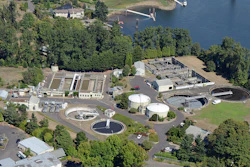
The reservoir was built in 1879; now it is one facet of a sprawling system that serves about a million people around the metro Louisville area. Redundancies and supply management practices are in place so that taking one basin offline temporarily will have no impact on the wider water ecosystem. All in, Crescent Hill can hold 110 million gallons of water, so a job like this takes real long-term planning.
It’s always a bit of a balancing act when upgrading critical infrastructure that is now more than 100 years old.
A reservoir with history and a lifespan
When Louisville Water first installed a flexible membrane liner system in the 1990s, the company was responding to a mystery. Residents living in the vicinity had reported water pooling in their basements despite clear skies. After draining one side of the basin, engineers discovered cracks in the original limestone walls. The liner solved the problem, and has served well for 25 years.
But even synthetic materials age.
Today’s project follows the same dual-basin approach as before: one side drained and restored while the other remains online, maintaining uninterrupted service. The north basin, now empty, reveals a thin layer of silt beginning to sprout grass. This first sediment removal step will take the better part of a year.
That process will give way to liner installation of the elastomeric geomembrane liner, detailed inspection, and then gradual refill before work flips to the south basin.
For customers, little will change. The reservoir’s dual-basin design allows one side to rest while the other continues supplying the system.
Behind the scenes, the reservoir remains a key element in Louisville Water’s treatment train, roughly a two-day journey from river intake to faucet. Water drawn from the Ohio passes through filtration and on-site chlorine generation before resting here, where operators monitor flow, quality, and turnover.
A model for long-term asset management
Louisville Water’s approach to the Crescent Hill project reflects a deeper institutional discipline: a willingness to invest in maintenance long before failure. The utility’s engineering team conducts routine condition assessments, replacing mains, valves, and coatings in a predictable capital cycle.
“We’re constantly doing condition assessments,” one Louisville Water spokesperson said during a recent Water Daily tour of the treatment facility. “Setting priorities around our capital budget—we know things have reached the end, and we need to make sure that we’re staying ahead of that.”
That mindset extends to modern tools: robotics for live main inspections, GIS-based asset tracking, and an evolving rehabilitation program that treats infrastructure as a living system rather than a list of projects. It’s a philosophy rooted in data, but sustained by public trust.
Communication as infrastructure
That trust is earned over the long haul. The Crescent Hill project isn’t happening behind closed gates. Louisville Water’s team holds open days at its historic Water Tower campus, operates a small museum, and invites residents to see how water moves from the Ohio River to their taps. Those same values guide project communication: timely updates, plain-language explanations, and a visible commitment to doing the work right.
“It’s a trust factor, right?” the spokesperson told Water Daily. “They trust that we’re making good decisions about how to manage our infrastructure.”
Louisville Water has spent years cultivating a culture of transparency, from its proactive lead-service replacement program to its open-door education initiatives. In an era when many utilities fight for funding or attention, this one has made infrastructure part of the civic story.
 Photo: Louisville Water
The long view
The relining of Crescent Hill is expected to stretch into 2027, with sediment removal on the north basin continuing through next year before relining begins. Once complete, the south basin will undergo the same process. The payoff will be invisible but vital: another quarter-century of reliable storage for a system that serves nearly a million people across Jefferson County.
In a field often focused on crisis response, Louisville Water’s quiet investment in prevention may be the most forward-thinking move of all.
It’s what happens when a utility sees its 19th-century reservoir not as an artifact, but as a living promise.