Lake Oswego will soon be replacing its Tryon Creek wastewater treatment plant, citing age and a need to meet modern sustainability standards set forth by the state of Oregon.
Retrofitting the existing facility would cost upwards of $1 billion, while construction of a more environmentally friendly operation has a projected price tag of $700 million. Having selected the second option, the city of Lake Oswego is mitigating costs through a low-interest financing tool administered by the Environmental Protection Agency.
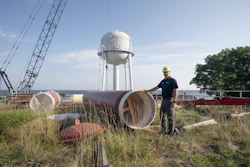
 The city of Lake Oswego has secured a $123 million WIFIA loan to replace its aging Tryon Creek wastewater treatment plant. Photo: portland.gov
The Water Infrastructure Finance and Innovation Act provides long-term supplemental loans for initiatives like Lake Oswego’s new wastewater facility. In August, city officials gave final approval for a $123 million WIFIA loan, based on a cap of 49% for the project’s eligible expenses.
Among WIFIA’s advantages – particularly for a mid-sized city like Lake Oswego – is the ability to defer loan repayment until the plant’s anticipated opening in 2028. Traditional bond financing does not offer this flexibility – its immediate principal repayment requirement would also be passed down to ratepayers quickly.
As it stands, the city has increased its utility rates by 3.9% annually, a trend expected to after the new facility is operational. Without the loan, those rates would have gone up by 35%, or $31.40 monthly, noted Stefan Broadus, director of special projects for Lake Oswego.
“(WIFIA) gives us access to capital funds immediately while deferring repayment,” Broadus said. “The outcome is we can raise our rates slowly to start paying off this huge capital contribution, as opposed to raising them abruptly. A 4% annual increase is consistent with inflation.”
As most municipalities cannot use existing reserves for large infrastructure projects, WIFIA is a handy vehicle for putting these initiatives in motion, said Broadus.
“It’s like a home mortgage, because most people can’t afford to buy a house with cash,” he said. “A mortgage provides monthly payments that the property owner can afford, despite the interest increasing the total overall cost of the house. A WIFIA loan can help pay off the project without large increases to utility rates.”
‘Being a good neighbor’
According to its website, WIFIA is “an EPA-operated bank that provides supplemental, flexible, low-cost credit assistance to public and private borrowers for all types of wastewater, drinking water and stormwater projects. The WIFIA program offers long-term loans that can be combined with State Revolving Fund assistance, municipal bonds, and federal and state grants to help communities deliver more critical water infrastructure projects for a lower cost with less impact on ratepayers.”
Beyond a deferred pay schedule, EPA’s guidance led to a Finding of No Significant Impact declaration, effectively streamlining the environmental review for the new plant and accelerating its construction. With the loan, the city will build a facility in the Foothills area, replacing a current plant built in 1964.
After breaking ground next year, construction will begin on a site designed to operate without the offensive odors of the existing facility. The new plant will also be smaller to make room for additional local redevelopment.
Refurbishing a facility at the end of its life cycle was not feasible given the necessary equipment and infrastructure upgrades, said Broadus.
“It’s so expensive, because we would have to find ways to keep wastewater treatment operation going while building improvements,” Broadus said. “There’s also limitations on energy efficiency and performance when trying to get old equipment to meet modern performance standards.”
In addition, the Tryon Creek plant predates the majority of safety standards set forth by the International Building Code. The forthcoming plant will meet Risk Category IV standards, ensuring it runs uninterrupted in the event of a major disaster.
Even in its early design phase, the forthcoming facility is being engineered to incorporate the most advanced water treatment technology available. Ideally, new treatment processes will reduce the concentration of organic matter and suspended solids in treated water by 50% during dry-weather periods.
The plant will also match the surrounding community from an architectural standpoint – what Broadus called just one measure of “being a good neighbor.”
“We have objective criteria for odor and noise based on industry standards in our region,” said Broadus. “Those efforts will be monitored and enforced. As for aesthetics, we want a cost-effective site that fits in well with the area.”
None of this would be possible without accessible federal financing as provided by the EPA, Broadus added.
“WIFIA may not be the perfect fit for all projects, but cities that find themselves with a shortage of capital should give it good consideration,” said Broadus.