Racks of telecommunications equipment in part of a data center. Photo: Gregory Maxwell
The U.S. is already home to 5,000+ data centers, and that number continues to grow at an extraordinary pace. 10 GW in data center development is anticipated to break ground this year, with another 7 GW expected to reach completion.
As AI and cloud computing accelerate the development of data centers, more communities are opening their doors to these infrastructures—with natural incentives to do so. Data centers can bring in millions of dollars in tax revenue, while providing new job opportunities. But with said benefits comes concern over the strain these facilities will have on community resources.
A notable target in all this conversation: you guessed it, water.
Why do data centers use so much water?
Data centers are thirstier than most buildings. The typical facility consumes anywhere between 1 to 5 million gallons of water per day. As the Washington Post put into perspective, that’s as much water use as you’d find in a town of 10,000 to 50,000 people.
The majority of water consumption in data centers stems from their cooling systems. These systems run continuously to offset significant heat produced by the massive array of servers. The approaches to achieving this effect vary:
- Evaporative cooling uses water to absorb heat as it evaporates, cooling the air in the process. It’s energy efficient but also very water-intensive.
- Air cooling uses fans and outside air to cool servers without consuming water. It reduces water use but typically requires more electricity.
- Hybrid systems alternate between air and evaporative cooling based on weather conditions, balancing energy use with water conservation.
Speaking of weather conditions, it’s also worth noting how a data center’s water demands shift seasonally. Water use tends to spike in the summer months, as cooling systems combat higher external temperatures to maintain optimal conditions. Amid rising ambient heat, evaporative cooling systems become less efficient, requiring additional water to achieve the same cooling effect. This places even more strain on a community’s water resources.
Where the pressure is building
Northern Virginia is home to the world’s largest concentration of data centers, lending to its nickname of the “Data Center Alley.” Occupied by tech giants like Google, Amazon, and Microsoft, this data center hub was estimated to consume more than 1.85 billion gallons of water in 2023—a 64% increase since 2019.
While water consumption grows, the climate is changing. Virginia dealt with a severe drought in 2024, during which watch advisories were issued and water conservation was encouraged. The worst part of the drought just so happened to impact the same watershed that’s shared by Data Center Alley.
One of the other largest hubs for data centers is Phoenix, Arizona, which hosts around 707 megawatts of IT capacity. The Phoenix metropolitan area has become a popular choice for data center development for many reasons: low humidity, lax policies, tax incentives, cheaper electricity.
At the same time, though, Arizona is a water-stressed state. Phoenix in particular relies heavily on the Colorado River as a water source, but the water levels have been historically low due to variables like drought and less snowfall. Compensating for this has led to an overuse of groundwater sources.
What operators say they’re doing
Tech leaders behind some of the nation’s largest data centers have pledged to take action to curb water use in their facilities.
Microsoft, for instance, said its new data center in Mount Pleasant, Wisconsin will be the first to use a new closed-loop system to recycle water. The company estimates the new design will save about 91 million liters of water annually.
Amazon, meanwhile, has cited the use of recycled water for cooling at 24 of its data centers across the globe. While often reserved for irrigating parks and golf courses, recycled water can be of high enough quality—like in the city of Santa Clara, California—to be used in this manner. Recycled water is returned to the wastewater treatment facility after its run through the cooling system, so it can be reused again.
Both companies, alongside other industry giants like Meta and Google, have vowed to be water-positive by 2030—meaning they plan to replenish more water than they use in their operations.
While well-intentioned initiatives, the reality is that the majority of data centers still rely heavily on evaporative cooling and large water consumption. That being said, the data transparency around actual water use at individual data centers is limited, with these metrics sometimes labeled as confidential.
Another layer to all this: water-positive goals can rely on offsite replenishment projects that benefit an entirely different watershed. So while helpful, these efforts don’t necessarily reduce local water withdrawals at the point of use.
Why utilities should treat data centers like industrial water power users
With the copious amounts of water they consume, data centers and their rapid expansion are raising red flags for utilities.
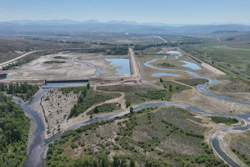
 Google Data Center, The Dalles, Oregon.
Yes, growth is expected—but the patterns behind that growth is a different story. Massive, always-on data centers can scale up quickly with little notice. That leaves little time for planning and investments to support new facilities.
When there are talks about system upgrades, utilities often find themselves in complex negotiations over who foots the bill and how rates are structured. These negotiations can quickly become contentious in communities where water access is already constrained.
This leads us back to the conversation around regions deemed attractive hubs for data center development. Areas that boast the benefits of lower costs, policy incentives, or climate are in many cases grappling with water scarcity. Adding high-consumption facilities to already-stressed systems can tip the scale, threatening service reliability to the surrounding community.
Smart planning, real solutions
Seeing just how thirsty data centers are, utilities have started to respond with more proactive, data-driven approaches. These include:
- Investing in predictive tools to model future water demand scenarios based on planned developments, including hyperscale data centers.
- Offering discounts or fast-tracking permits for data centers leveraging reclaimed or recycled water for cooling.
- Integrating data centers into existing or planned reuse infrastructure to help mitigate potable water demands and create a more circular cycle.
Alongside these efforts, there has been the introduction of tiered pricing structures, impact fees, and capacity reservation agreements. The goals are dual-sided: make sure new development pays for its share of infrastructure costs and encourage conservation to preserve water systems communities rely on.