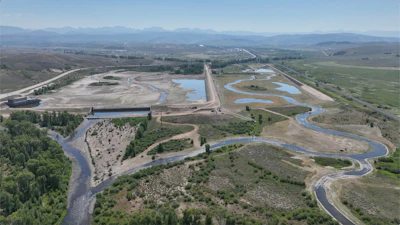
After decades of damage and deadlock, a stretch of the Colorado River in Grand County is flowing freely again, thanks to a rare alliance between water managers, conservationists, and local governments.
The newly completed Colorado River Connectivity Channel reconnects a long-blocked section of the river for the first time since the 1980s, restoring critical aquatic habitat and helping secure water for the rapidly growing northern Front Range. This was no small task.
 The newly created Colorado River Connectivity Channel at right, with the new configuration of Windy Gap Reservoir at left. Photo: Northern Water
Over 20 years in the making, the project has sustained a series of challenges and setbacks, the majority of which were negotiating a plan that meets the needs of all those who depend on the river and its water.
The swelling troubles with the Windy Gap Project
Built in 1985 to divert water to a growing population on the northern Front Range, the Windy Gap Project consisted of a diversion dam to create the 455-acre-foot reservoir, and a pump plant. By the ’90s, downstream communities and recreators were noticing negative effects.
The structure spanning the width of the river blocked fish and the natural movement of sediment. By 2011, state biologists reported a 38% loss of diversity downstream of the Windy Gap Project. Compounding the problem, the reservoir created conditions conducive for Myxobolus cerebralis— the parasite known to cause whirling disease in trout. A place once known for its Gold Medal trout fishery was seeing severely declining trout numbers. For years, the local community, conservationists, and nonprofit Trout Unlimited worked toward a connectivity project to restore the river to no avail.
It wasn’t just the downstream community experiencing challenges with the diversion. Northern Water, the utility operating the reservoir, wasn’t able to reliably collect its water rights from the project.
“During dry years, we might not ever have our water rights come into priority under the Colorado prior appropriation system, and so during those years the yield was zero,” says Jeff Stahla, public information officer for Northern Water.
In addition, Lake Granby, the primary storage place for Windy Gap water, doesn’t have the capacity to store all the water being diverted during wet years.
“By contract, it prioritizes that federal project water first and Windy Gap Project water is at a lower tier of priority,” says Stahla. This means Windy Gap was not able to store the additional water of wetter years.
For Northern Water, the situation came to a head after the severe drought in 2002, prompting it to move forward with plans to build storage for Windy Gap water only. However, to construct and redirect its water rights to a new reservoir, Chimney Creek Reservoir, the utility needed permits from Grand County, the very same county working to undo damage done by the Windy Gap Project.
A coalition is formed
“It emerged that one of the tasks that would [be a] move toward getting our permits would be a reconfiguration of Windy Gap Reservoir to allow the creation of an off-stream channel to move water around the reservoir during times of the year when we weren’t pulling our water rights from the Colorado River,” says Jeff Drager, Northern Water’s director of engineering.
 The historic alignment of Windy Gap Reservoir west of Granby. The completion of the Colorado River Connectivity Channel has reduced the size of the reservoir. Photo: Northern Water
The only way forward was to work together. But lack of trust from years of strife did not dissipate overnight.
“I remember a meeting that we had, and I think people were nervous that they were recording us. I don’t know that they were, but that was the level of lack of trust that we had between the two groups,” says Drager.
Despite the challenges, both groups continued to meet in person, and the conversations became more productive. In the end, they were able to build a plan that satisfied both parties: one that did not impede Northern Water’s operations while building a bypass that helped downstream health and fisheries.
“As we moved forward, having everyone involved, it went from being a project where none of us trusted each other to a project where we really worked together pretty well and came up with a well-functioning project.”
Funding
By completion, the connectivity project was a $33 million effort.
“That was two or three times what we thought it was going to be pricewise,” says Drager. The Natural Resource Conservation Service contributed nearly half at $16 million. Remaining funding came from multiple sources, including the state of Colorado, Northern Water, and Trout Unlimited, as well as from corporate sponsorships.
The first grant submitted from Trout Unlimited for NRCS funds was rejected. But thanks to the tenacity of Mely Whiting, the nonprofit’s legal counsel, the following year Trout Unlimited applied for a grant that included not only the connectivity channel but also channel improvements downstream to Kremmling.
“When the NRCS saw that it was a bigger project that covered a lot more ground on the Colorado River, they also agreed that it was important enough for them to provide a lot of funding,” says Drager. “[Mely] deserves a lot of that credit.”
Building the new reservoir and channel
The connectivity project broke ground in August 2023. The project plan was to build a 1-mile channel around the reservoir, effectively connecting this stretch of the Colorado River for the first time since the ’80s. In order to do this, they would need to decrease the size of the reservoir. A project like this, involving already existing infrastructure, seasonal flow changes, and a complex ecological system meant there were still challenges to overcome.
 Colorado River water flows through the newly built Colorado River Connectivity Channel west of Granby. Photo: Northern Water
“I was very nervous about designing and constructing it,” says Drager. “We were designing something in a reservoir that had been flooded for 40 years, so it was different from a construction perspective.”
Northern Water used the CM/GC contract, which allowed the GC to be at the table during the design phase. “It worked really well because you got the design engineer in the room with the contractor that was going to build it,” says Drager.
The project timeline was three years, since the winter months and the high flow in the spring didn’t allow for any construction. “We had to do it in a stepped sequence, so having that contractor on board working through that with the engineer really helped.”
When the opening ceremony took place in October 2024, it was attended by a group of people who had once been at odds sitting side by side. They were all there to see if their efforts had paid off.
“When this channel was built, Colorado Parks and Wildlife put in some sensors to detect when tagged fish would go by, and immediately after the channel was opened, they were starting to get signals that fish were using it,” says Drager.
It’s also been reported that sculpin, considered a marker fish that life is returning to the river, have been detected in the channel. “The insects are coming back, and the sediment is setting up in the right way to encourage this very small kind of a feeder fish for the larger trout,” says Stahla.
Project work to restore aquatic habitat in Kremmling are still under way, and an additional mile of fishery is scheduled to open in 2027.
Firming water rights for the growing northern Front Range
The collaborative effort of the Connectivity Channel paved the way for the Windy Gap Firming Project, which broke ground in August 2023, marking the end of a 20-year permitting process for Northern Water. The new Chimney Creek Reservoir, scheduled to be completed this year, will move storage of the Windy Gap water rights from Lake Granby to Larimer County.
As water conflict and negotiations along the Colorado River rage on, this consortium proved that collaboration could bring great ideas to the table. “If we wanted to move our project forward, we needed to open our minds a little bit and be willing to look at different options. Once we were willing to do that, Grand County and others that were involved in the process were too,” says Drager. “The biggest advice I would give is to just sit down and really listen to the people on the other side and really understand what they want and [to] make sure they know what you want and what you need too.”