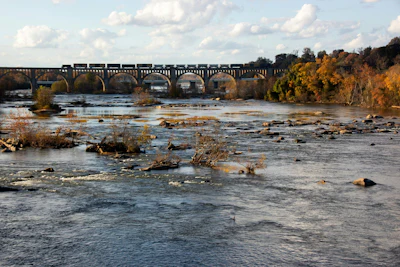
 James River
The James River Water Project, a long-gestating effort to secure water resources for two growing Virginia counties, is moving forward amid a series of complex challenges, including discussions about the project’s impact on ancestral lands.
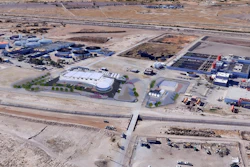
Last August, Louisa and Fluvanna counties broke ground on a water intake and pumping station, a sign of progress for a region with a dwindling well and groundwater supply.
- The project had faced an unexpected roadblock when an initial pump location on the James River was identified as a tribal capital and burial site by the Monacan Indian Nation.
The James River Water Authority (JRWA), established in 2006 as a joint effort between Fluvanna and Louisa, agreed to move the facility two miles upstream at a cost of about $20 million, said Justin Curtis, an attorney for the water authority.
“This is a historic area for Native American populations in Virginia,” said Curtis. “Anywhere you have water, you have people. So this project became more complex, because there are Native American sites up and down the river.”
The Monacans’ tribal capital, known as Rassawek, was located at the confluence of the Rivanna and James rivers. The pump site’s selection sparked controversy around 2018, when the Virginia Department of Environmental Quality (DEQ) awarded a permit to the JRWA for the facility’s construction. Relocation of the station necessitated a renewed permitting process, which concluded last April when the authority received certification from the Army Corps of Engineers.
In March of this year, the Virginia General Assembly enacted legislation mandating that all state agencies consult with federally recognized tribes on projects that could impact native lands. Gov. Glenn Youngkin’s signature on the bill would empower tribes to more effectively advise state agencies on land use.
James Reynolds, field director for the Virginia Department of Health’s office of drinking water, acknowledges the importance of increased indigenous involvement in transformative infrastructure projects.
“We know the [Monacan] were not federally recognized for a long time,” Reynolds said. “Once they were, a lesson we learned was to involve them in the process as soon as possible. It’s important to get their input, and understand the cultural impact of these projects. You have to take that into consideration when you go through permitting.”
A changing landscape
With permit in hand, the JRWA will be authorized to withdraw 8.57 million gallons of water daily from the new pumping site. The total cost of the project is about $56 million, split equally between Louisa and Fluvanna counties.
Since the groundbreaking, significant progress has been made on a six-mile-long waterline connecting to the pump station and a second waterline. Architectural design for the pump facility is expected to conclude this spring, with construction slated for completion in 2026.
Reynolds said the involved counties can no longer rely on local wells to support a rapidly growing population.
- Between 2020 and 2023, Louisa experienced a 7.5% population increase, while Fluvanna saw a 3.5% increase, according to census figures.
In 2003, the jurisdictions signed an agreement to develop Zion Crossroads, a burgeoning mixed-use community at the southwest corner of Louisa. The region’s ongoing development necessitates a stable water source that would replace increasingly insufficient bedrock water supplies. This problem was intensified in 2011 by a 5.8-magnitude earthquake near Mineral, Virginia, which led to well damage and widespread groundwater fluctuations, noted Reynolds.
“The main needs here are to provide a plentiful and reliable source of water compared to groundwater in the area,” said Reynolds. “Groundwater is taken from fissures in bedrock, which have more susceptibility to drying out or changing. Once everything is constructed, waterlines will get extended throughout the counties. Then there’s opportunity for more places to connect to the water system and disconnect from private wells.”
Moving forward
According to Reynolds, the James River plan will not only secure drinking water for the region. In addition, it will improve water access for local firefighting units, lessening their dependency on drought-vulnerable lakes and rivers.
Apart from the cultural hurdles that initially delayed progress, the water project has mostly proceeded as planned, said Curtis, the water authority attorney.
- “The historical challenges were the biggest issue, but everything else was garden variety,” Curtis said. “Permitting anything in Virginia is a challenge, but it’s the same regulatory process that takes place in most states.”
Virginia is no stranger to water-related issues. During the 2000s, Virginia disputed with Maryland regarding increased local water withdrawals from the Potomac River. The interstate disagreement culminated in a U.S. Supreme Court ruling that favored Virginia, affirming its right to draw water from the Potomac free from Maryland’s regulation.
With the James River plan a reality, Curtis anticipates a promising future where everyone has access to sufficient water.
“I’m happy and relieved that this vitally important project is under construction,” Curtis said. “It’s a shame that public infrastructure can get tied up for long periods, but this is good for all parties moving forward. This can be an example for other collaborative water projects around the state.”