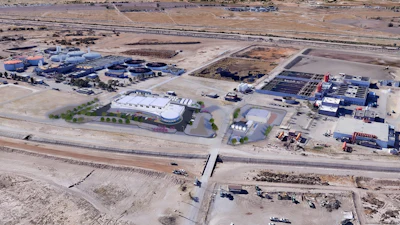

In a patch of high desert along the southern border, El Paso, Texas, is rewriting the playbook for urban water resilience. The city has just recently broken ground on a $295-million direct potable reuse (DPR) facility, the first of its kind and scale in the U.S. to send treated wastewater straight into a public drinking water system.
This plan has been in the works for at least a decade, and El Paso Water is moving forward now because it’s important and sensible to diversify water supply sources as greatly as possible. The El Paso Pure Water Center will come online in 2028, delivering 10 million gallons per day (MGD) of purified water to city residents. That’s enough to cover 6% of peak summer demand.
 El Paso Pure Water Center rendering; the facility will come online in 2028. Courtesy of El Paso Water
“We’re simply executing a water resource strategy that’s been put in place by past water directors,” says Gilbert Trejo, vice president of operations and technical services at El Paso Water. “We’re doing our part to implement the next step in diversifying our water portfolio, which is needed for our city to thrive out here in West Texas.”
El Paso, a drought-prone city of 800,00, has been steadily ramping up its water conservation goals–including diversifying its supply sources. This aspiration runs from the utility on down to the end customer. In planning ahead for an uncertain future of water supply, El Paso is not alone in thinking big.
Scaling up
The Pure Water Center is the culmination of over a decade of planning, piloting, and waiting for the right moment to pull the trigger. Going as far back as 2007, when El Paso opened the largest inland desalination plant in the world, it’s been clear that the city is focused on strategic water supply diversification.
El Paso Water then launched a DPR pilot project around 2015 as a key step in validating the treatment technology and preparing for full-scale DPR. But it wasn’t just a technical exercise, it was also a strategic move to build public trust and regulatory confidence. DPR is a tough technical shift to convey clearly to customers, so El Paso took the opportunity to let residents see this pilot for themselves; seeing is believing, as Trejo says.
The pilot system used the same treatment train now planned for the full facility: membrane filtration, reverse osmosis (RO), ultraviolet (UV) disinfection, and granular activated carbon (GAC). It demonstrated that this multi-barrier approach could meet or exceed drinking water standards.
“By 2015 the technical work was done,” Trejo says. “We had the design planned. But then utility life gets in the way.”
El Paso originally hoped to launch the project in 2018. But other utility priorities, rate pressures, inflation, and a global pandemic got in the way.
This is surely familiar for other utilities juggling the gamut of public projects.
“Here we are staring 2030 in the face,” Trejo says now. “From a utility management standpoint, it’s just around the corner. So we really had to make a decision from a financial standpoint that we needed to move forward with this project now.”
That delay wasn’t free. The original cost estimate? $130 million. Today? $295 million and counting.
And 2030 is not a random timeline; Trejo points out that water demand models showed a pressing need to secure another source of water by then. Even despite the delays, El Paso is right where it wants to be to meet its population needs.
Public trust
From a process standpoint, the project isn’t necessarily reinventing the wheel. The treatment train—membrane filtration, reverse osmosis, UV advanced oxidation, granular activated carbon (GAC)—is made up of tried-and-true components.
Caroline Russell, principal technologist at Carollo Engineers, says that her firm has designed the El Paso Pure Water Center unit processes of membrane filtration, RO, UV, advanced oxidation, GAC, many times before. The approach is normally the same: Look at site-specific water quality and design criteria, mind the site constraints, and then design a plan to meet the goals for that specific project. El Paso simply put together those steps at a larger scale with an eye toward cutting-edge technologies, and it’s been an exciting project for her and the firm.
 El Paso Water
“What was different is that there was not a regulatory pathway to get the state regulatory approval for some of the things that we were doing,” she says, such as the direct-to-distribution aspects of this project. “It just required work and effort to illustrate to the regulators how the unit processes were achieving the required treatment goals.”
The facility’s treatment sequence meets or exceeds all state and federal drinking water standards.
And that work has paid off.
El Paso’s approach helped shape Texas’s guidance on potable reuse, creating a template that future projects can follow. In fact, one of the steps pioneered in this facility is now codified in state guidance—a rare case of utility work influencing state regulation.
Talking about DPR
And yet the public engagement side of this utility project is its own sensitive process. This is not a one-slide-deck sell, of course. It requires patient, personal conversations—lots of them. Trejo doesn’t mince words: “This is much more a social project than a technical project.”
And the utility learned early that jargon breeds fear. “If you’re scaring your customers, that’s not a good thing,” he said.
Public tours of El Paso’s pilot facility have made a difference. When residents see crystal-clear treated water next to tap water, and they can’t tell the difference? That lands.
Since 2016, El Paso Water has hosted more than 50 public meetings, facility tours, and education sessions. By 2023, customer surveys showed over 90% community acceptance of the DPR concept—proof that the long-game approach to trust-building can work.
Broadly speaking, too, the public is working along a steep learning curve and understanding the many efficiencies to be gleaned from new infrastructure like this. As opposed to further pipeline development, let’s say, a facility like the Pure Water Center provides a clear public investment in new water treatment methods.
Russell echoed the broader logic. “When you compare the ability to recycle water locally versus these significant pipelines … it just makes sense to not be pulling water from one area that may eventually need it. We have the technology to allow for that.”
The RO question
Both Trejo and Russell pointed to a possible future where reverse osmosis isn’t even part of the equation. Not because it doesn’t work—it absolutely does, impeccably well—but because it creates another problem: brine disposal.
Generally, Trejo says, he favors a “non-RO based train” when possible; this would focus on ozone, GAC, biological filtration. And the science is catching up. GAC is proving effective against PFAS. The precedent already exists in places like California. El Paso itself has used a non-RO train at its Fred Hervey facility for decades.
“When reverse osmosis is not needed to meet salinity goals for purified water, using a carbon-based treatment train where you use ozone and biological filtration and GAC alleviates some of the concern with concentrate disposal,” Russell says.
For now, El Paso’s brine management strategy involves blending RO concentrate with treated effluent from the Roberto R. Bustamante Wastewater Treatment Plant and discharging it under a state-approved permit. It’s a practical workaround with limits, but one that works at this scale.
Will the non-RO train become the new industry norm? Maybe not yet. But it should be on the table.
A proof point for the industry
El Paso is showing that you don’t need to wait for a catastrophe to do something bold. You just need a clear vision, a serious long game, and a willingness to have tough conversations.
“We’re hoping that our project gives folks the confidence to say, you know what? A pretty big city is doing something like this,” Trejo says. Already, nearby drought-prone cities like Phoenix and Tucson are looking into these sorts of investments.
He adds: “Do these projects out of diversification, not out of desperation.”