The Sugar Creek Water Treatment Plant in Canton, Ohio, is one of three water treatment plants serving the city. It’s also the largest of the three plants, serving over 50,000 residents, which is more than half of the department’s customer base.
The city’s Northwest and Northeast Water Treatment Plants underwent significant renovations in the early 2000s. While at Sugar Creek, looking at backwash settling lagoons with engineers who led those renovations, the team stopped to consider how they hadn’t done a comprehensive renovation since the plant was built in the 1960s.
This conversation led them down a path to renovate the Sugar Creek plant, navigating the balance between old and new structurally alongside the logistical challenges of having the city’s largest water treatment plant under construction.
A full-plant survey and blueprint for reliability
When the engineering firm came into the Sugar Creek facility, they surveyed all the components within the plant, from the plumbing and electrical to the HVAC, roofing, valves, motors, and well fields.
“We had to look at it through the eyes of whatever might fade within the next 25 years,” stated Tyler Converse, Canton’s Water Superintendent, who has been with the department for over three decades. “If there’s something that’s not going to make it 25 years, we need to look at replacing it now and set it up for a 25-year cycle.”
 The original Sugar Creek Water Treatment Plant building, constructed in the 1960s.
Another priority within the renovation was to build redundancy into the plant. For instance, there was only one raw line coming up to the well field, and while they wanted to clean it, they couldn’t. So redundancy with the water mains was a need.
The well field, meanwhile, featured all overhead electric. The plant had experienced power outages in the past due to limbs falling from trees around the electrical lines. With the updates, they opted to put the electrical underground and then split it so they could take certain wells offline without killing the whole well.
Where mid-century style meets modern design
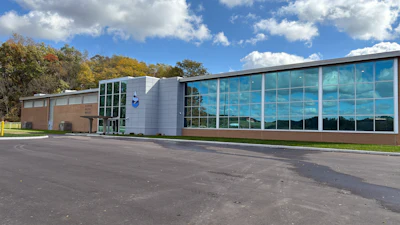
Burgess & Niple, the engineering team behind the plant’s renovation, describes the original building as having a “distinctive mid-century style.” Elements of that original style were preserved in the new layout.
On the exterior, they held onto a concrete overhang out front of the building that represented the architecture back in the 1960s. Inside, they kept the original terrazzo flooring, blending in some patchwork where needed after redoing surrounding walls. Also preserved was a hand-crafted tile mural in the lobby showing the cycle of water.
While the front entrance and mural were more intentional from a design standpoint, the preservation of the floors and other building elements was more-so economic.. The shell of the building was structurally sound, so the team wanted to preserve that.
“Our goal was really to keep this plant exactly as it was architecturally,” Converse said.
In other areas, modern design changes came into the fold, while still honoring the plant’s original structure.
For instance, big glass blocks on the building’s face had become discolored and frosted white, making it difficult to see through them. The team replaced those blocks with tinted blue glass — symbolic of the water industry, visually beautiful, and energy-efficient — that fit the original building’s structure and dimensions.
 The preserved mural in the lobby of the Sugar Creek Water Treatment Plant.
Brent Burrier, the Assistant Superintendent who has been with the water department for over a decade, notes the value of having a monetary buffer in place for these kinds of surprises.
“Have an allowance you can pull from because once you get into this kind of renovation, you never know what you’re going to find behind a wall.”
Keeping clean water flowing while construction carried on
Construction on Sugar Creek’s $37 million renovation lasted for three years, wrapping up in 2025. As Converse notes, it was very challenging to keep the plant online in that window, while at any time part of the facility or its mechanical parts were down for replacement or repair.
In Converse’s words: “How are we going to sequence this and keep the rest of the plant not only operating, but operating and producing safe, quality drinking water?”
One of the strengths of the project, as Converse describes, was in the relationship with Burgess & Niple as well as the Great Lakes Construction Company. The three companies shared a like-minded philosophy, standards, and way of doing business.
“That’s part of what not only gave us a really good product in the end, but helped us finish on time and on budget, and throughout the duration produce safe drinking water,” Converse stated.
The success of the Sugar Creek Water Treatment Plant renovation was recently celebrated with a 2026 Outstanding Achievement Engineering Excellence Award from the American Council of Engineering Companies (ACEC) of Ohio. The award recognizes projects that showcase innovation, technical excellence, and meaningful impact in the state.
For a plant that produces an average of 14 million gallons of water a day, the upgrades provide an added layer of confidence for the Ohio community it serves.