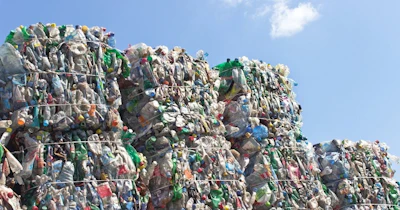
This summer, Oregon implemented a landmark extended producer responsibility (EPR) plan for packaging, paper and food serviceware. The comprehensive law shifts the financial burden of managing packaging waste to producers from local governments and taxpayers, while acknowledging the inadequacy of traditional recycling systems.
Established under the state’s Plastic Pollution and Recycling Modernization Act, the initiative uses fees from packaging producers to upgrade Oregon’s recycling infrastructure. Enforcing accountability ensures the proper management of single-use plastics and related items, preventing them from polluting their surroundings, program supporters told Water Daily.
“If our goal is to improve the impact of materials on the environment, then recycling alone is not sufficient,” said Arianne Sperry, the Oregon Department of Environmental Quality’s implementation lead for the Recycling Modernization Act. “There’s also a need to look upstream before people buy products – the law is about reducing materials before we get them in our hands.”
Since the recycling act became law in 2021, the Oregon DEQ and other stakeholders have been working to develop an EPR framework. Washington-based Circular Action Alliance (CAA) will serve as the designated Producer Responsibility Organization (PRO) tasked with managing the program, said Sperry.
The alliance is jointly governed by founding members from the food, beverage, restaurant, retail, and consumer goods sectors, said CAA communications manager Alex Bertolucci. By penalizing non-compliance in item collection, sorting and processing, the law can motivate designs that enhance recyclability and reduce waste, Bertolucci said in an email.
“Our members have experience participating in and leading packaging EPR programs in other parts of the world,” said Bertolucci. “They have drawn on that experience to build a U.S. PRO that seeks to achieve harmonization of compliance services across states, while implementing program plans that meet the unique needs of each state.”
So far, so good?
Oregon DEQ is responsible for regulatory oversight of the initiative, a role that encompasses the communication of compliance standards and statutory requirements. To date, over 2,600 producers have registered for a Uniform Statewide Collection List, which details materials suitable for collection. Packagers are also required to submit brand and material data through the alliance’s online registration portal.
Producers will contribute fees based on the type, weight and recyclability of materials they place on the market. Through this eco-modulation structure, participants are incentivized to minimize waste and integrate sustainable materials into their operations, noted Recycling Modernization Act PRO plan lead Nicole Portley.
“We need that to stick on the enforcement side, because if you have mass non-compliance, the few producers that have complied will bear the cost,” Portley said. “That can lead to disaster.”
The DEQ has issued 700 warnings for non-compliance since the EPR program was rolled out five months ago. Delinquent producers may face daily civil penalties of $20,000, or have their products pulled from store shelves following repeated infractions. However, packagers can leverage performance data to refine their production methods and packaging designs.
In the meantime, larger fees are tied to plastics and other difficult-to-recycle items. Under the program, the plastics industry is required to meet water quality and wildlife standards established by Operation Clean Sweep, an effort dedicated to eliminating nurdle waste in the environment.
“With our waterways, there’s need for more policy,” Portley says. “By shoring up the recycling system with producer funding, you hopefully keep more plastic in the waste management system.”
What about plastic?
Launched on July 1, the EPR program has already shown some early signs of success, said Bertolucci of CAA. Oregon recently introduced new drop-off recycling sites, while ongoing education and outreach gives residents a thorough overview of the EPR roll-out.
Observers are encouraged by a plan meant to, in part, address the plastic pollution cycle affecting local marine and freshwater health.
“When it comes to plastic pollution, I don’t see the situation in Oregon as any different than other states,” said Susanne Brander, an environmental toxicologist with the Oregon State University college of agriculture sciences. “We’re all dealing with the same issues, like too much plastic waste, or the production of biobased plastics without ways to manage the waste.”
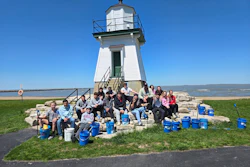
Nurdles represent a major environmental threat to the Oregon coast, where these small plastic pellets are monitored and collected by Oregon Coast Aquarium’s Nurdle Patrol and Environment Oregon.
 “This [EPR program] will be a climb out of this plastic pit we’ve dug ourselves into,” said Susanne Brander, an environmental toxicologist at Oregon State University.
For water and wastewater utilities, Oregon’s EPR framework represents a rare upstream intervention that could ease downstream operational burdens. By pushing producers to reduce hard-to-recycle plastics and improve material design, the program has the potential to lower the volume of microplastics, packaging debris, and nurdles entering stormwater systems and treatment plants.
Over time, fewer plastics in the waste stream could translate into reduced screening and removal costs, lower risk of environmental permit violations, and less pressure on aging infrastructure already struggling to manage non-organic solids. While the impacts won’t be immediate, utilities will be watching closely to see whether producer-funded recycling reforms meaningfully reduce the plastic load they’re increasingly being asked to treat.
Above all, Oregon’s EPR framework is a reminder that mitigating plastic pollution requires strategies beyond simple recycling, Brander said.
“We’ve known this for decades, and the plastic industry has known this for decades,” said Brander. “With this program, it starts to put word out about reduction. It will be slow, and there are outlawed materials that are still in use, but it will be a climb out of this plastic pit we’ve dug ourselves into.”
While taking a “wait-and-see” approach on Oregon’s ambitious undertaking, she is encouraged by a program that could serve as a model for other states.
“It’s good seeing collective action,” Brander said. “Oregon can reduce plastic and microplastic pollution, while inspiring other states to join in and pass similar legislation.”