With the EPA’s first-ever national PFAS drinking water standards now finalized, water and wastewater utilities are entering a new phase of operational planning: not whether to treat PFAS, but how quickly they can design, fund, and operate systems that meet federal limits.
By 2029, most public water systems will be required to comply with a 4 ppt MCL for PFOA and PFOS, along with new Hazard Index rules for additional PFAS compounds. At the same time, CERCLA liability and state-level discharge limits are accelerating pressure on wastewater facilities, landfills, and industrial pretreatment programs.
The challenge is not simply technical—it’s financial and strategic. No single PFAS solution works for every source water type, flow rate, co-contaminant load, or disposal pathway.
Utilities now face decisions around:
- Capture vs. destruction technologies
- Residuals management (landfill, offsite treatment, full mineralization)
- Life-cycle cost, labor intensity, and media replacement cycles
- Pilot testing capacity and lead times from vendors
The past three years have produced rapid innovation in both PFAS removal and destruction. Many of the options that were “research only” five years ago are now entering commercial deployment.
This roundup provides a practical overview of the leading technologies being evaluated and installed today—what they do, where they work, and what utilities need to know before selection.
Capture
The first step to managing PFAS contamination is removing it from groundwater, wastewater, and landfill leachate.
Capture technologies range from chemical addition, absorption, and physical barriers.
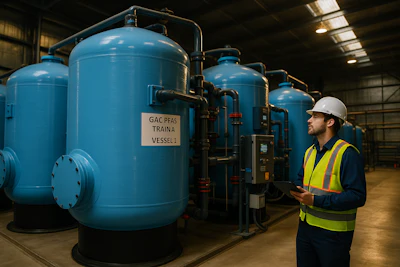
Granular Activated Carbon (GAC): GAC is pulverized carbon that is “activated” by being heated to high temperatures without the presence of oxygen, opening pores and increasing its surface area. Already widespread in water treatment plants for odors, toxic chemicals, and organic compounds, GAC is a well-documented method for removing PFAS from water, particularly long chain PFAS.
How it works: Carbon has a reputation for reacting with most carbon-based contaminants. As contaminated water passes through open beds or pressurized vessels of GAC, much like a home water filter, dissolved PFAS react and bind to the activated carbon, decontaminating the water. The captured PFAS remain bound to the GAC until it is reactivated.
Ion Exchange (IX): IX is a chemical process that reacts with ionic (positively or negatively charged) water contaminants like PFAS with an equal and opposite charge in the form of a solid resin. Like activated carbon, IX pulls PFAS from a dissolved state in water to a physically bound form and is already used to treat water contaminants at treatment plants globally.
How it works: As the name indicates, water contaminants are “exchanged” with the ionic resin as they react with one another, removing the contaminant from the water and replacing it with a harmless substance. While most PFAS chemicals hold an anionic charge (meaning negative, or more electrons than protons), this diverse group of chemicals can also hold cationic (positively charged, more protons than electrons) and zwitterionic (equal and opposite charges) properties.
Reverse Osmosis (RO) membranes: RO membranes are semi-porous sheets that feature ultra small pores (0.1 nanometers). Typically made from polymeric materials, RO membranes are a proven water treatment technology, used in drinking water plants, home water filters, and desalination applications.
How it works: Water is placed under pressure inside RO cartridges or vessels. This pressure pushes water through the membranes’ pores, while water contaminants as small as viruses, salt, and PFAS chemicals are physically blocked from passing. This separates water from its contaminants, leaving behind a brine as the clean water is transported to the next stage of treatment.
Foam fractionation: At airports and air force bases, a common PFAS contamination source is aqueous film forming foam (AFFF), a product that was widely used for fire suppression. As scientists asked themselves how to separate PFAS from water, the idea of returning it to its foamy form birthed the idea of foam fractionation.
How it works: Contaminated water or leachate is percolated with air bubbles, agitating the water and causing PFAS to foam to the surface (like soap in a bubble bath). This PFAS-laden foam, known as “foamate”, floats to the top of the water, effectively separating water and PFAS. The foamate is vacuumed off the water surface.
“Foam fractionation works best on long-chain PFAS compounds. Shorter-chain PFAS don’t behave the same way because they’re less hydrophobic,” explained Dave Kempisty, VP of Technology at Montrose Environmental. “We’re finding ways to make foam fractionation more precise and efficient. We refined the geometry of our reactors, optimized hydraulic retention times, and dialed in the benefits of foam boosting agents. Systems are also being designed to reuse water and air within the process, reducing energy requirements and making it more sustainable.”
Coagulation/Flocculation: Coagulants are commonly used in water treatment to neutralize organics by changing their charge. This allows organics that once repelled one another to gravitate toward each other, clumping together and creating heavy “floccs” that sink to the bottom of clarifiers and tanks. This same approach is also being tested specifically for PFAS capture.
“PFAS precipitation integrates easily into existing water treatment systems with little to no capital investment. Many operators find the process similar to polymer or flocculant and dosing rates can be optimized,” said Pamela Lynch, President of Cornelsen Inc. “This approach is also scalable and can be adjusted as regulations evolve.”
Capturing PFAS chemicals and separating them from water and waste streams is a well-established science. However, after capture, facilities are left with high concentrations of PFAS to dispose of. Spent GAC and RO brine are often sent to the local landfill or wastewater treatment plant, meaning the contamination continues. For communities and industries dedicated to ending the PFAS contamination loop, the next step is destruction.
Destruction
PFAS destruction technologies consist of chemical, pressure, and heat approaches to weaken and break the carbon-fluorine bond, resulting in free fluorine, non-PFAS organics, or no organic byproducts whatsoever.
Supercritical Water Oxidation (SCWO): We often learn about water in its three states: gas, liquid, and solid. However, in a controlled environment, more states become possible. When water is placed in a pressurized vessel at 3,205 pounds per square inch (221 bar) and heated to 705 Fahrenheit (374 ℃), it exhibits a “supercritical” state. In this state, water is not truly a liquid or a gas but partially behaves like both. It also makes organics in the water especially sensitive to change. With an injection of air into this environment, oxygen and carbon react and break bonds instantly, destroying every organic compound present, including PFAS.
“If you put enough heat and pressure on something, it’s going to change. That’s how you make diamonds. With water at a certain temperature and pressure, it destroys organics,” explained Naomi Senehi, technical solutions lead at 374Water.
Incineration: Like a fire transforming logs into ash, incineration is a controlled, high temperature process commonly used to dispose of toxic waste at industrial facilities. For those trying to destroy PFAS, combustion shows potential to be a final destination.
Electrochemical Oxidation (EO): This technology comprises metal electrodes (essentially sticks of titanium, boron, and stainless steel) that are immersed in polluted water and wastewater streams. An electric current is run through these electrodes to produce oxidizing compounds, like hydroxyl radicals and ozone, that directly and indirectly interact with PFAS and break them down. EO has been used to treat other organic pollutants at treatment plants, while commercial scale installations for PFAS are currently deployed.
“One of the major advantages of electrochemical treatment is the ability to maintain the conditions necessary for degradation as long as needed to achieve the overall destruction result, ensuring complete mineralization of long chain to ultra-short chain PFAS.” Andrew Mrasek, Chief Revenue Officer at Axine Water Technologies.
Ultraviolet Light (UV) and photochemical reagents: UV light has been used for water and wastewater disinfection for decades. UV rays inactivate and destroy bacteria that pose risks to human and environmental health. Applying this technology to PFAS destruction, UV light weakens the carbon-fluorine bond, making it easier to degrade with chemical reagents.
“For the first time, a viable, closed-loop destruction solution is commercially available. This moves the industry beyond the traditional methods of landfilling or incineration,” explained Mitch Koffel, Vice President of Sales at Claros Technologies. “It enables compliance with stricter regulations and mitigates PFAS liability, ensuring long-term protection of water resources.”
In the field: In 2025, Claros’ proprietary UV-photochemical process achieved over 99.99% destruction of targeted PFAS compounds, successfully treating more than 170,000 gallons of wastewater in a high-flow system capable of achieving hundreds of gallons per minute. This successfully demonstrates that large-scale PFAS destruction of long, short, and ultra-short chain PFAS using UV technology is not only technically feasible but also economically viable.
Hydrothermal Alkaline Treatment (HALT): The HALT process involves an additive, typically sodium hydroxide, to PFAS-contaminated water, raising its pH. The water is then conveyed to a vessel where it undergoes high pressure and temperature conditions to break the C-F bonds with the help of the high pH. Once PFAS are destroyed, water is brought to a more neutral pH for further treatment and discharge.
In the field: At an industrial plant with waste streams containing short and long chain PFAS, as well as co-contaminants, many PFAS destruction solutions struggled to consistently treat its waste stream. Using the HALT system, over 99% of short and long chain PFAS were destroyed in a waste stream with up to 10% total dissolved solids. Ultimately, the operations cost was $0.10 per gallon of treated water.
Only the beginning
As concerns persist around PFAS’ ongoing impact on human health, technologies like these are tools for cities and industry to capture and take control of the problem.
The technologies listed here are only some of the solutions being piloted, innovated, and deployed to address this national contamination as effectively as possible at water and wastewater treatment plants, landfills, and industrial facilities.