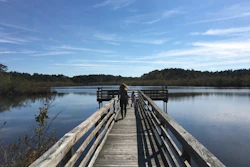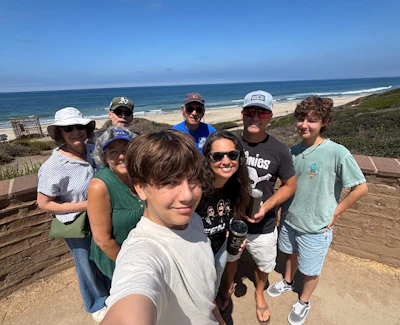
 Bethany Case and family. Photo: Bethany Case
Bethany Case has fond memories of Imperial Beach, a San Diego County coastal escape defined by a four-mile stretch of sand along rolling blue waters. Until recently, the beach was the site of many sun-drenched strolls and lazy afternoons boogie boarding with her children.
While Case still lives in Imperial Beach, life by the water is not what it used to be. The beach itself has been closed to swimmers for over 1,000 days, due to a relentless surge of noxious pollution flowing from the Tijuana River. Billions of gallons of sewage, trash and toxic chemicals have polluted the Pacific Ocean, a decades-long problem that has ballooned into a crisis for residents on both sides of the border.
Imperial Beach, located just five miles north of the Mexico border, is California’s southernmost beach town. Bordered by the Tijuana River estuary, the community is a direct recipient of the waterway’s most severe pollution, bringing a smell that, depending on the day, shifts from an overflowing Port-A-Potty to a throat-scorching chemical burn.
“I walk out of the house and take a smell test, which sounds so ridiculous,” said Case. “But it makes the difference between whether I walk the dog in the morning, or walk him later. At school, my kids have to stay inside for recess, or eat their lunch in the gym.”
The complex cross-border problem has been worsened by years of neglect and an overall lack of funding. Yet, a recent accord between the neighboring countries has given residents and community advocates interviewed by Water Daily a sliver of hope.
In late July, the U.S. and Mexico signed a memorandum of understanding that outlines specific steps and a new timetable to clean up the untreated wastewater spilling across the border. The agreement updates a formal bilateral work plan, known as the Minute 328 memorandum, adopted in 2022 by the U.S. International Boundary and Water Commission (IBWC).
Per the accord, Mexico will fast-track $93 million in improvements to the Tijuana sewage system. The country will also undertake up to six additional infrastructure projects to accommodate future population growth and maintenance needs.
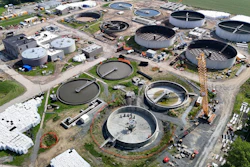
Meanwhile, the U.S. has vowed to release funds to complete expansion of the South Bay International Wastewater Treatment Plant north of the border. The agreement calls for the plant to double its current capacity to 50 million gallons per day by the end of 2027.
Though observers like San Diego Coastkeeper executive director Phillip Musegaas view the news with skepticism, he is encouraged to see at least some effort to find a permanent solution to an enduring issue.
“The main benefit is that (the agreement) accelerates the timeline to do repairs and infrastructure upgrades,” said Musegaas, whose nonprofit environmental group is committed to protecting the waters of San Diego County. “Without a new timeline, this work would stretch at least another decade.”
Problems on both sides
The 120-mile-long Tijuana River traverses the Mexico coast into Southern California, where it flows through Navy-owned land to the Pacific. Aging wastewater plants in Mexico have failed to keep pace with the region’s industry and population boom. As a result, more than 100 billion gallons of raw sewage have flowed into San Diego County since 2018.
Pollution has sickened swimmers as well as Navy SEALs who utilize the ocean for training. Nor is this problem limited to the water, noted Musegaas.
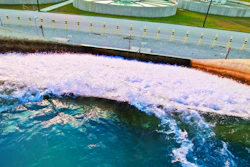
 Tijuana River pollution. Photo: Adriana Heldiz
“There are air impacts, too,” Musegaas said. “There are places in the river valley where it’s like a little waterfall, and you’re getting foam and spray into the air. People are inhaling this bacteria.”
Residents like Case fear for the health of their families due to the presence of aerosolized contaminants. Case herself has suffered from gastrointestinal problems that she believes are linked to airborne toxins from the river. Worsening ailments like asthma have become a growing concern among her neighbors, who believe their proximity to the river is to blame.
“I had pneumonia for the first time this year, and my kids have been getting headaches,” Case said. “The chemicals and bacteria are in the air, and you’re ingesting them. There has to be a connection there.”
The recently penned bi-national agreement came three months after U.S. EPA administrator Lee Zeldin met with Mexican officials. A border visit gave Zeldin a view of the degraded river valley, not to mention a nose full of raw sewage laden with trash and industrial chemicals.
Since 2020, more than $653 million has been allocated to address cross-border pollution, with Zeldin blaming the Mexican government for the failures of previous efforts. Yet, the dilapidated South Bay treatment facility managed by the federal IBWC has suffered numerous operational and maintenance failures, resulting in chronic pollution of coastal waters and the river estuary, said Musegaas.
“This plant is taking sewage from Tijuana, not treating it much, then discharging it into the ocean,” Musegaas said. “It’s misinformation to say that (the pollution) is 100% Mexico’s fault. This is racist, politically-based rhetoric. There’s confusion on who’s responsible for treating wastewater, so the undercurrent to all this work is putting out good information to the public.”
A bipartisan issue
Ramon Chairez, a South Bay resident and education coordinator with Un Mar de Colores , is taking the latest effort to solve the crisis with “a grain of salt,” he said.
“We’ve been here before, because this issue has been around so long,” said Chairez. “We’ve seen a culture of neglect and lack of commitment to previous agreements. We are on standby. None of us would be surprised if either country fell back on its commitment.”
The IBWC has proposed expanding the South Bay sewage plant’s daily capacity from 25 million to 35 million gallons as soon as the end of August, with a longer-term treatment goal of 50 million gallons per day. Mexico is also committed to increasing the capacity of the San Antonio de los Buenos treatment plant, which was recently repaired after years of delay.
Though Chairez tries to remain optimistic, he believes simply stabilizing faulty infrastructure is not enough. Developing long-term sustainability will take years, bolstered by research and an engaged community pushing for nature-based solutions encompassing new parks and greenspace.
“Let’s create a space that people are proud of,” Chairez said. “Otherwise, we’ll be at the mercy of developers, urban sprawl and more natural spaces being swallowed up by an expanding city. It’s a grim alternative.”
Case, the Imperial Beach resident, said clean water must be a bi-partisan issue. Not only among politicians, but citizens as well.
“We have people who want a secure border and to hold Mexico accountable, and another side that wants to keep people healthy,” said Case. “There has to be political will. It’s there and it’s growing, it just needs more funding.”